
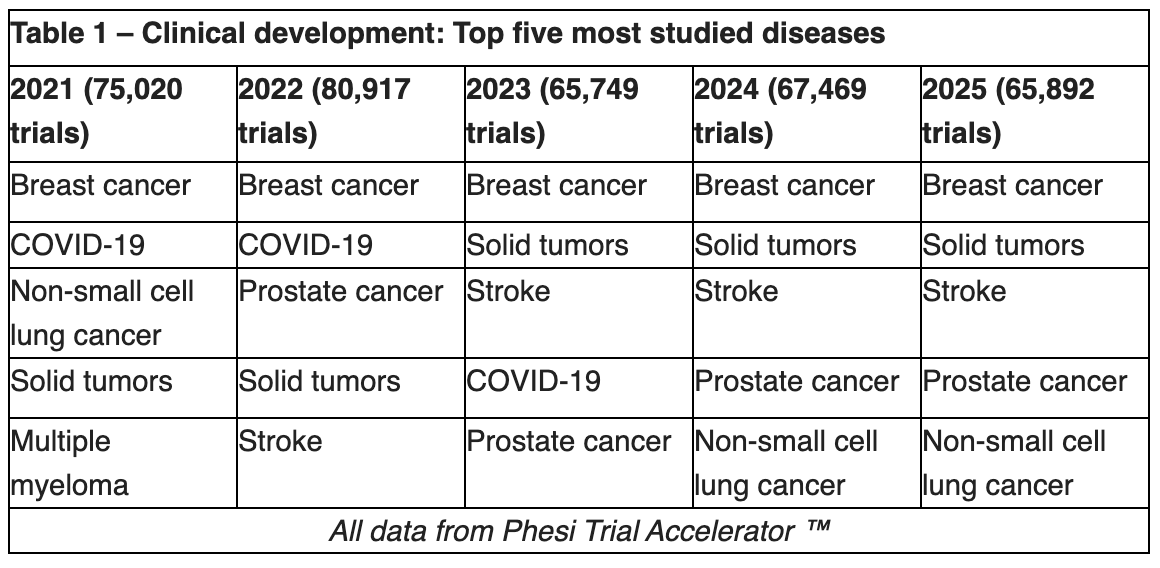
Phesi has released its annual report on the world’s most studied diseases, analysing data from 65,892 recruiting clinical trials in its AI-driven Trial Accelerator platform.
The findings show that breast cancer across all subtypes (from triple-negative to PIK3CA) remains the world’s most studied disease for the fifth year running.
The top five were rounded out by solid tumours, stroke, prostate cancer and non-small cell lung cancer (NSCLC).
The report also showed a small improvement in trial attrition; however, a quarter (26%) of trials are still terminated in Phase II.
China ranks second for all of the top five, except for prostate cancer, where Canada takes second place.
China also recorded the strongest growth in investigator site numbers between 2023 and 2025, increasing by 51% compared with 42% for the US. France, Italy and Spain complete the top five countries for recruiting investigator sites. 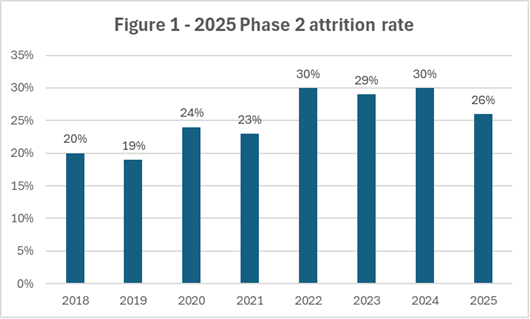
"While it is positive to see trial attrition rates fall, a quarter of Phase II trials ending early is still unacceptably high," commented Dr Gen Li, founder and president of Phesi.
"Sponsors remain under pressure from macroeconomic constraints, pricing challenges and increased activity in regions such as China."
"We are also seeing the effect of renewed emphasis from regulators, including the FDA, on country-specific representation."
"Well-known and high-profile investigator sites are quickly saturated as sponsors seek them out."
"However, there is considerable opportunity to identify investigator sites elsewhere that may have a shorter clinical trial and enrolment history, but have capacity and have delivered high-quality data in previous trials."
Obesity remained just outside the top five most studied diseases, ranking sixth in 2025.
A separate Phesi analysis in September 2025 showed that more than 100 diseases are being investigated in connection with GLP-1 use, reflecting growing interest in obesity as a comorbidity in a wide range of diseases.
This increase indicates that obesity is the disease area most likely to enter the top five within the next one to two years.
Rising GLP-1 usage will also influence clinical development in other fields, as obesity is an important comorbidity and weight loss may alter study parameters, dosing and endpoints.
"Sponsors should now be looking ahead to what the next disruptor might be," continued Dr Li
"The broader adoption of GLP-1s, for example, could reshape the clinical development landscape as the focus shifts towards prevention and treating clusters of related disease."
Phesi has published annual reports on the world’s most studied diseases since 2021 and issues regular analyses on global clinical development.
These reports draw on the award-winning Trial Accelerator platform, the world’s largest contextualised clinical trial database.