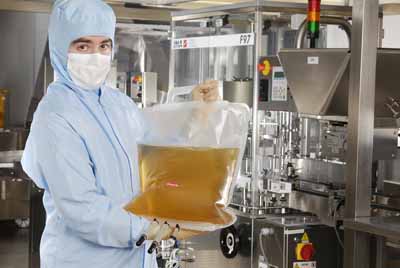
More convenient format for media fill broth
Animal-free media fill broth is now available in ready-to-use bags
The BPCs are manufactured from a medical grade plastic film that meets USP Class VI requirements and are certified free from animal-derived components. Connection is made through a male or female connector that is attached to the BPC with C-Flex tubing.
Oxoid cfVPB is also certified free from animal-derived components, making it ideal for production environments in the pharmaceutical industry, where there is a need to control the risk of contamination from animal-derived materials–particularly with the emergence of diseases such as transmissible spongiform encephalopathies (TSE).
‘BPC’s provide an efficient means for companies to save time and resources,’ said Maria Higgins, pharmaceutical applications manager, Oxoid products. ‘The containers reduce waste and lower cleaning costs. Moreover, the BPCs minimise the risk of cross-contamination, allowing companies to meet regulatory standards.’ says the company.
The cfVPB is gamma-irradiated at a dose validated to be lethal for all yeasts, moulds and bacteria, including bacterial spores and mycoplasmas. The BPCs are, likewise, gamma-irradiated. The medium is prepared using water-for-injection–quality water. The BPCs are aseptically filled, ensuring that the prepared medium is suitable for use in pharmaceutical clean room support areas. The product is also accompanied with quality certification providing full traceability for each batch.
The broth is available as standard in 10 and 20 litre volume BPCs; other sizes are custom-made.

You may also like
Manufacturing
BD and Suttons Creek collaborate to streamline combination product development for pharma and biotech
Read moreThe new strategic collaboration will help pharmaceutical and biotech companies reduce development risk and regulatory complexity across drug-device combination products, including biologics and GLP-1 therapies
Trending Articles
-
You need to be a subscriber to read this article.
Click here to find out more.
You may also like
Manufacturing
BD and Suttons Creek collaborate to streamline combination product development for pharma and biotech
The new strategic collaboration will help pharmaceutical and biotech companies reduce development risk and regulatory complexity across drug-device combination products, including biologics and GLP-1 therapies
Regulatory
FDA approves AstraZeneca's Saphnelo Pen autoinjector in systemic lupus erythematosus
AstraZeneca has received FDA approval for a once-weekly subcutaneous autoinjector formulation of Saphnelo for systemic lupus erythematosus, offering patients a more convenient alternative to the existing intravenous infusion
You need to be a subscriber to read this article.
Click here to find out more.
Regulatory
UK clinical trial reforms come into force in largest regulatory overhaul in 20 years
The MHRA and Health Research Authority are implementing the most significant package of clinical trial regulatory reforms in more than two decades, introducing faster assessment routes for lower-risk trials and mandatory registration of trial results
Regulatory
FDA grants Orphan Drug Designation to pegrizeprument for prevention of heart transplant rejection
The FDA has granted Orphan Drug Designation to pegrizeprument (VEL-101), a novel monoclonal antibody fragment licensed to Veloxis Pharmaceuticals, for the prevention of heart allograft rejection, following a similar designation granted for liver transplant rejection in January 2026
Manufacturing
Miltenyi Biotec and CHA Biotech collaborate on BaEV lentiviral vector platform
The pair will work to enhance CAR NK cell therapy manufacturing efficiency, combining Miltenyi Bioindustry's baboon envelope lentiviral vector platform with CHA Biotech's NK cell research expertise to improve gene delivery, scalability and cost of goods
You need to be a subscriber to read this article.
Click here to find out more.
Regulatory
Britain's biotech potential (part I): world-class science, second-class support?
The UK produces top-tier life sciences research, offers favourable conditions for early-stage investment and hosts a growing network of internationally competitive clusters. So why does the capital keep leaving?