
The ECHA has added two substances to the Candidate List of substances of very high concern (SVHC), which now contains 253 entries for chemicals that can harm people or the environment.
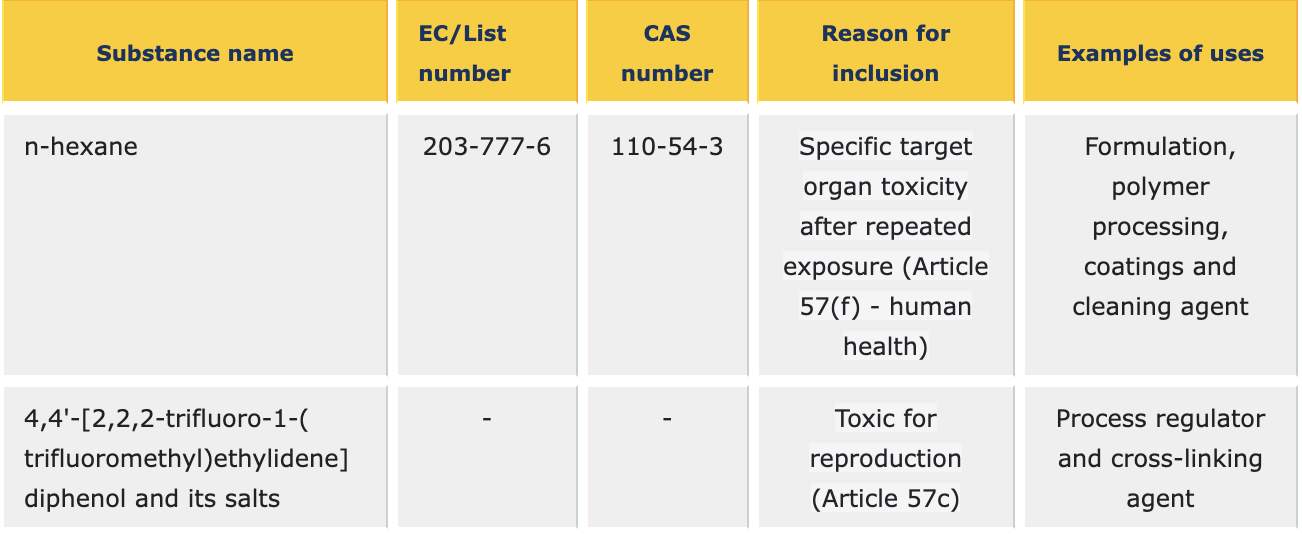
The newly added substances are n-hexane and 4,4'-[2,2,2-trifluoro-1-(trifluoromethyl)ethylidene]diphenol and its salts.
Some examples of their usages are in formulation, polymer processing, coatings, cleaning agents and as process regulators and cross-linking agents, respectively.
Entries added to the Candidate List on 4 February 2026:
The list now contains 253 entries, with some of these entries covering groups of chemicals, so the overall number of impacted chemicals is higher.
These substances may be placed on the Authorisation List in the future. If a substance is on this list, companies cannot use it unless they apply for authorisation and the European Commission authorises its continued use.
Why this matters
Under REACH, companies have legal obligations when their substance is included — either on its own, in mixtures or in articles — in the Candidate List.
If an article contains a Candidate List substance above a concentration of 0.1 % (weight by weight), suppliers must give their customers and consumers information on how to use it safely.
Consumers have the right to ask suppliers if the products they buy contain substances of very high concern.
Importers and producers of articles must notify ECHA if their article contains a Candidate List substance within six months from the date it has been included in the list (4 February 2026).
EU and EEA suppliers of substances on the Candidate List, supplied either on their own or in mixtures, must update the safety data sheet they provide to their customers.
Under the Waste Framework Directive, companies also have to notify ECHA if the articles they produce contain substances of very high concern in a concentration above 0.1 % (weight by weight).
This notification is published in ECHA’s database of substances of concern in products (SCIP).
Under the EU Ecolabel Regulation, products containing SVHCs cannot have the ecolabel award.
