

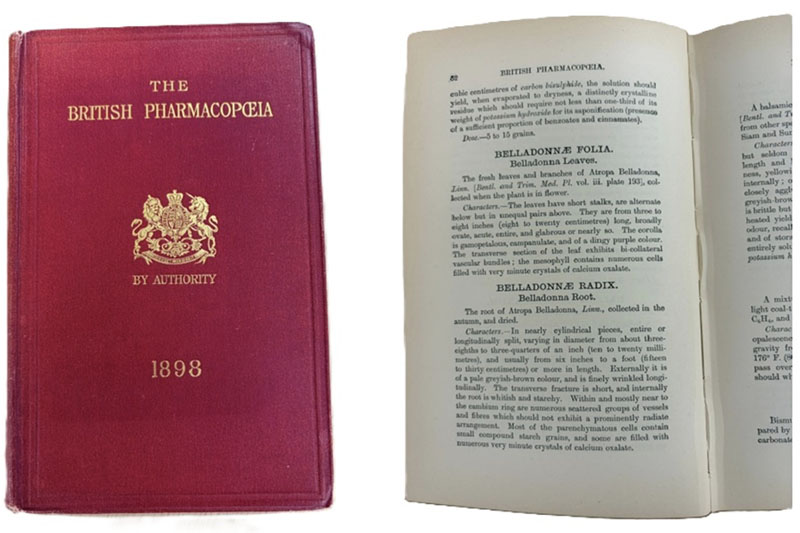
When I graduated as a chemist from the University of Edinburgh in 1990, notes Frank Judge, Consultant Chemist at Butterworth Laboratories, my mother gave me a copy of the 1898 4th Edition of the British Pharmacopoeia (BP).

It was beautifully bound in red, with the name, year and coat of arms embossed in gold leaf.
I did not then know that, from 1994, when I joined Butterworth Laboratories, I would spend the next 30 years involved in Analytical Quality Control (AQC) testing for pharmacopoeial compliance.
As Chemist-in-Charge of the chromatography laboratory, I used to break the ice during client audits by returning from my office with the 1898 edition and assuring auditors that Butterworth used only the most up-to-date methodologies.
Background
The BP was established in 1864 under the Medical Act 1858, which tasked the General Medical Council with combining the pharmacopoeias of England, Scotland and Ireland.
Before then, separate official pharmacopoeias existed, notably the London Pharmacopoeia (first published in 1618), the Edinburgh Pharmacopoeia (1699), and the Dublin Pharmacopoeia (1618).
The purpose and content of the BP in 1864 were fundamentally different from those of the BP 2026.
In 1864, the pharmaceutical industry was only beginning to evolve. John Boots, for example, had opened a small local business in Nottingham in 1849.
The founding BP restated the instruction of the 1858 Act on the first page of the preface: the BP should be “a Book containing a list of medicines and compounds, and the manner of preparing them together with the true weights and measures by which they are prepared and mixed, and containing such other matter and things relating thereto.”
Earlier British pharmacopoeias contained only basic identity tests and focused mainly on finished preparations for compounding by individual pharmacists. These tests included
- volumetric titration: used for assays of inorganic substances
- gravimetric analysis: widely used for precipitation, residue and ash determinations
- specific gravity/density: important identity/purity tools.
There wasn't a single edition in which the BP suddenly changed from being predominantly instructional into an analytical pharmacopoeia.
It was a gradual transition, but there were particularly important turning points between 1914 and 1932.
The years of increasing change
The 1914 BP is arguably the first edition in which a deliberate separation can be seen between the preparation of a medicine and its analytical examination.
Chemical identification reactions that had previously been repeated in individual monographs were compiled in appendices.

The 1914 edition also introduced a substantial new section of general reactions and tests for substances mentioned in the text, covering numerous inorganic elements, ions and salts.
At this point, the BP was beginning to say: this is how the substance should be identified and how its purity should be demonstrated, not merely how the pharmacist should make it.
1932: the real watershed?
The sixth edition, BP 1932, marked a major transformation. The Macmillan Enquiry had led to the creation of a new Pharmacopoeia Commission in 1928, and the sixth edition was published in September 1932.
Its monographs were substantially expanded and reorganised. For drug substances, the pattern became much closer to that of the modern pharmacopoeia:
Characters → Tests for Identity → Tests for Purity → Assay
Pharmacopoeial articles were no longer defined simply by formulation. Monographs began to specify minimum content, identity tests, impurity tests and assays.
The 1932 BP did not completely abandon recipes for finished preparations, but monographs increasingly enabled examination of the finished medicine. In 1864, the BP told the pharmacist what to use and how to prepare it.
By 1932, the question had become: “Does the resulting preparation meet the specified chemical potency?” The following summary shows the main stages in the BP's development from 1864 to 1973.
- 1864: primarily a recipe/formulary: ingredients, proportions and methods of preparation
- 1885: still predominantly recipe-based, but increasingly includes tests for identity and purity
- 1898: increasing analytical content; chemical tests becoming more systematic
- 1914: a major step toward analytical standards; general chemical tests consolidated into appendices
- 1932: major transformation: monographs substantially rewritten around identity, purity and assay
- 1948: analytical control firmly established
- 1953–1968: increasing use of quantitative chemical analysis and instrumental methods
- 1968: the Medicines Act 1968 established the legal status of the BP and the British Pharmacopoeia Commission in their modern form
- 1973: from here onward, the modern concept of pharmacopoeial specifications and analytical methods was firmly established.
After 1973, the BP's development was shaped less by the question of whether analysis belonged in the pharmacopoeia and more by which analytical techniques offered the most reliable means of demonstrating identity, purity and potency (Table I).
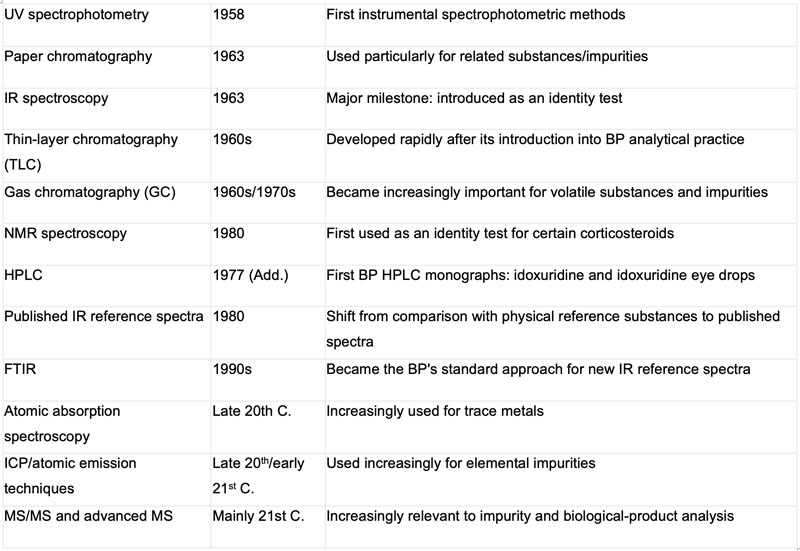
Table I: Development of advanced analytical techniques in the BP
The broad historical pattern is clearest when followed through a single medicinal preparation.
Belladonna Tincture shows how the BP's emphasis moved from correct preparation towards measurable strength, identity and specification control.
Belladonna Tincture: an example of the increasing analytical control within the BP
The Belladonna Tincture monograph illustrates the central theme: the BP’s gradual shift from prescribing how a medicine should be prepared to specifying how its quality, identity and strength should be demonstrated.
The three editions, 1864, 1932 and 2000, show three distinct stages in that development (Table II).
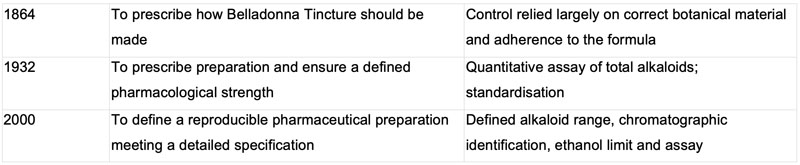
Table II: The evolution of the Belladonna Tincture monograph
The purpose of the British Pharmacopoeia is now fundamentally different from that expressed in the founding legislation of 1864.
It provides the United Kingdom's authoritative official standards for pharmaceutical substances and medicinal products, supporting the MHRA's role in protecting public health and providing standards for pharmaceutical research, development, manufacture, quality control and analysis.
Bibliography
- General Medical Council, British Pharmacopoeia 1914 (Constable & Co., London, UK, 1914).
- A.C. Cartwright, "The British Pharmacopoeia, 1864 to 2014: Medicines, International Standards and the State," https://doi.org/10.4324/9781315614182. Chapter 2, “Middle Years: 1914–1968” and Chapter 7, “Changes in Analytical Methods 1864–2014.”
- Committee of Civil Research, Sub-Committee on the British Pharmacopoeia. Report. Cmd. 3101. London: His Majesty's Stationery Office; 1928. (The Macmillan Report).
- The British Pharmacopoeia, "Proposals for a Standing Commission," British Medical Journal 1(3516), 915–917 (1928).
- General Medical Council, British Pharmacopoeia 1932 (Constable & Co., London, UK, 1932).
- G.R. Kitteringham, "The British Pharmacopoeia Commission," Progress in Medicinal Chemistry 6, 1–10 (1969).