
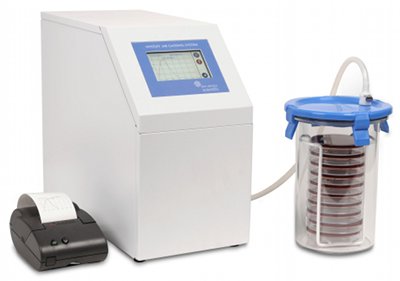
The West Yorkshire, UK-based firm says the system runs from one cylinder of mixed gas and there are separate cycles to prepare anaerobic or microaerobic conditions. It takes less than two minutes and about 18p to create an anaerobic environment, and just 15 seconds and less than 3p to achieve microaerobic conditions.
According to the company, laboratories with low sample throughput can justify this system as a compact and cost-effective alternative to a workstation.
Using the Whitley jar gassing system also eliminates chemical waste and reduces condensation so that samples can be handled and read more easily following incubation, the company says.
Optional accessories include adaptor kits for reusing existing anaerobic jars.
Jar gassing system gains a colour touch screen
And an optional printer for traceability, auditing and accreditation
You may also like

Trending Articles
You may also like
Manufacturing
![Patented device reinvents Solid Phase Extraction]()

Patented device reinvents Solid Phase Extraction
Biotech Fluidics announce SPEedy - a device that provides an effortless way to perform Solid Phase Extraction (SPE) sample preparation procedures without need of an external vacuum and compatible with any adsorption chemistry or eluent composition
Manufacturing
![Orano Med inaugurates Europe's first industrial-scale lead-212 radioligand therapy facility]()

Orano Med inaugurates Europe's first industrial-scale lead-212 radioligand therapy facility
The €29m ATLab site will target up to 10,000 doses annually and its two-hour proximity to major European airports meets the critical 24-hour production-to-administration window imposed by lead-212's 10.6-hour half-life

Manufacturing
![Catalent launches ten-month gene-to-drug substance programme for complex biologics]()

Catalent launches ten-month gene-to-drug substance programme for complex biologics
The accelerated pathway extends the CDMO's Rapid Antibody framework to bispecifics and next-generation formats — targeting master cell bank release by month seven and bulk drug substance lot release by month ten
Design & Build
![Sterling Pharma Solutions doubles ADC manufacturing capacity at Deeside with new GMP suite]()

Sterling Pharma Solutions doubles ADC manufacturing capacity at Deeside with new GMP suite
The multi-million-pound expansion adds a 1400 sqft Grade C cleanroom, OEB5 containment handling and a 3400 sqft analytical laboratory — extending Sterling's bioconjugation capability from development through to Phase III and commercial scale
Manufacturing
![Piramal Pharma Solutions and NP2 to complete cyclophosphamide development phase next month]()

Piramal Pharma Solutions and NP2 to complete cyclophosphamide development phase next month
Piramal Pharma Solutions (“PPS”), a leading global Contract Development and Manufacturing Organisation (CDMO) and part of Piramal Pharma Ltd. (“PPL”) (NSE: PPLPHARMA | BSE: 543635), and its partner NP2, a nonprofit generic drug manufacturer, today announced their plans to finish the drug development phase of the generic cancer drug cyclophosphamide in October