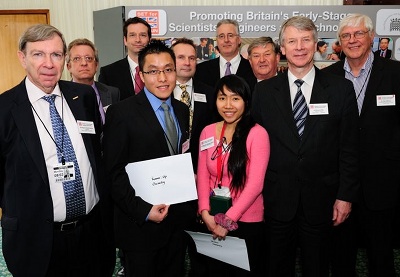
Medal awarded to ThaoNguyen Nguyen for Porphyrin-DNA poster
A PhD student from the School of Chemistry at Southampton University has won the Roscoe Medal, which was presented by RSC and AgChemAccess at the SET for Britain event, held at the House of Commons.
ThaoNguyen Nguyen was awarded the medal for her poster that looked at the use of Porphyrin-DNA as a scaffold for nanoarchitectures. The poster was judged the best chemistry presentation.
ThaoNguyen’s research focuses on the use of DNA as architecture for Porphyrin chromophore arrays (natural molecules found in heme or chlorophyll) for applications in future nanochips and potentially in photodynamic therapy for cancer treatment. The results show that DNA has great potential for the transformation from being a building block of life to being a building block for nanotechnology.
SET for Britain aims to encourage, support and promote Britain's early-stage and early-career research scientists, engineers and technologists to ensure continued progress in the development of UK research and r&d, and ultimately the future of UK business. The awards give early-career scientists the opportunity to communicate state-of-the-art science to Members of Parliament and scientific peers.
ThaoNguyen’s poster also won the EPSRC Award for Young Scientist at the UK Nano & Emerging Technologies Forum last year, hosted by the Nano Knowledge Transfer Network (NanoKTN) and UK Trade & Investment (UKTI). Being a NanoKTN member and winning the EPSRC Award contributed towards ThaoNguyen’s success at SET for Britain and has had a great impact on promoting her research.
‘Winning the Roscoe Medal and the EPSRC Award has given me opportunities to communicate my research to a broader audience, one that I would not normally expect to meet,’ she said.
‘Embedding an awareness within the next generation of current research will help to strengthen business and hopefully create further connections between academia and industry.’
Established by the Technology Strategy Board, the NanoKTN is managed by Centre for Process Innovation, a technology development and consulting company.