Gold nanoparticles use DNA to deliver anti-cancer drug
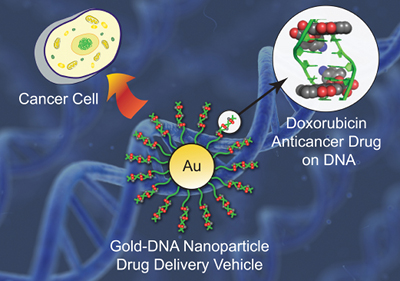
Scientists at Syracuse University's Chemistry Department in New York, US have created a new drug delivery system that is expected to advance the effectiveness of cancer drugs. It uses gold nanoparticles with attached DNA that binds to anti-cancer drug, Doxorubicin (DOX).
Preliminary tests indicate that this delivery device has the potential to improve the results of cancer chemotherapy. DOX is currently used against cancers of the breast, bone marrow, thyroid, bladder, ovary, small cell lung and several others.
‘The possibilities of this new system are really exciting,’ said Professor James Dabrowiak at Syracuse University. ‘It would be easy to add to the device molecules that have the ability to target cancer cells. Another possibility is using light excitation to release high concentrations of an anti-tumour drug directly within the tumour.’
These and other upgrades could enable doctors to focus chemotherapy more tightly on cancer cells and reduce side effects on healthy cells in other parts of the body.
A key element of the system is that the DNA attached to the gold particles is engineered to bind to the DOX drug. Studies show that DOX can be transferred by diffusion to a receptor DNA molecule.
The gold nanoparticles have an average diameter of only 15.5nm or a few billionths of a metre. A single nanoparticle presents more than 100 DOX sites and that, when multiplied by millions of particles, could create a massive assault on a tumour, the researchers have found.
‘We believe this work can bring significant gains in the effectiveness of chemotherapy treatments,’ said Mathew Maye, Assistant Professor of Chemistry at Syracuse University and co-inventor of the delivery system. ‘We still have work to do but this advance opens a promising new field of investigation that can lead to important new clinical tools.’
The US FDA has already approved DOX. Other such drugs may be deployed using this system simply by engineering the DNA to bind to a different drug molecule.
The Syracuse researchers are continuing investigations to check the toxicity of the system. They will also explore ‘smart’ particles capable of attaching to cancer cells and responding to triggers that will activate drug release.
The work of the Syracuse team is published in a February 2011 issue of ChemComm, published by the Royal Society of Chemistry.