

Researchers at the University of Oxford have, for the first time, directly observed individual virus-like particles assembling step by step, offering pharma manufacturers new mechanistic insight that could inform the design of antiviral drugs and the engineering of vaccine platforms.
The findings were published in Nature on 16 September.
The study, led by the Department of Chemistry and Kavli Institute for Nanoscience Discovery at Oxford, used an engineered virus-like particle made of 60 protein units to track how these building blocks come together to form a capsid — the protein shell that protects a virus's genetic material.
Rather than relying on before-and-after snapshots or theoretical modelling, the team combined mass photometry, an Oxford-developed technique that measures individual molecules via light scattering, with a new confinement method that let them observe a single particle continuously as it grew.
Illustration of virus-like particle self-assembly. Protein building blocks can repeatedly join and leave the growing particle. When they form a closed face, multiple connections lock the building blocks into place, providing stable intermediate structures from which the particle can continue to assemble. Structures rendered from PDB ID 7B3Y using ChimeraX software. The illustration was subsequently edited using Claude (Anthropic). Image credit: Roi Asor.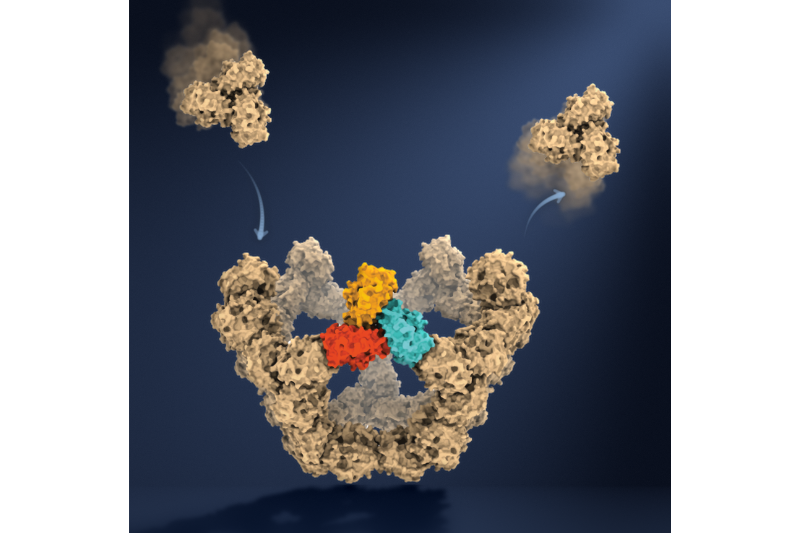
How the assembly process works
The researchers describe the process as resembling a maze in which only productive routes lock into place.
Protein subunits initially form weak, reversible bonds, allowing failed arrangements to fall apart and retry, until a small number of stable intermediate structures act as waypoints that funnel the process toward a complete particle.
A key turning point comes when five larger protein units close into a pentagonal ring (the first genuinely stable structure in the pathway), after which assembly accelerates as fewer additional components are needed to reach each subsequent stage.
Co-lead author Dr Roi Asor (Department of Chemistry and Kavli Institute for Nanoscience Discovery, University of Oxford) said the work reveals the physical rules behind an "extraordinary construction problem," in which viral components find the correct arrangement among vast numbers of possibilities with no blueprint or directing machinery.
He added that "the weak interactions give the system room to make mistakes."
Most encounters don't have to be successful: the components can separate and try again. But once enough of them come together in the right closed arrangement, the structure becomes stable and assembly can move forward.
"That combination of trial and error followed by locking in successful structures is what makes the process so reliable."
Co-first author Dan Loewenthal, a PhD student in the same department, said the new method allows the team to study assembly directly, adding: “We just take a video!"
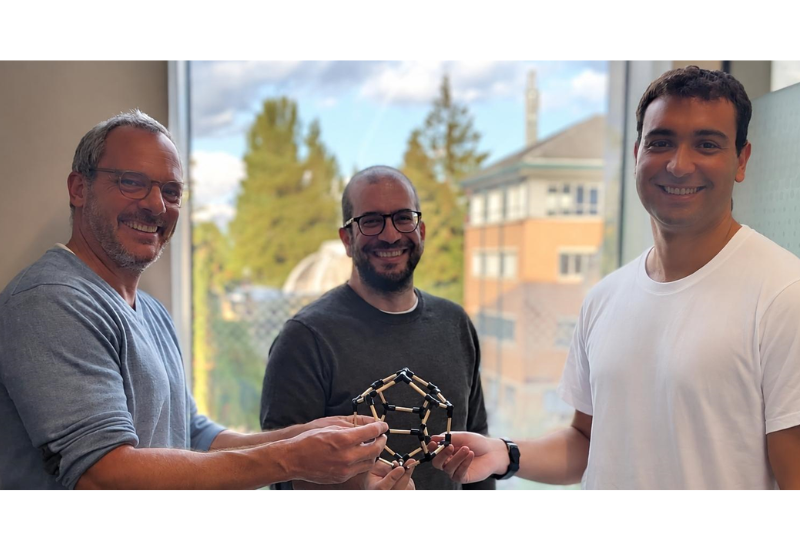
The research team from the Department of Chemistry and Kavli Institute for Nanoscience Discovery who led the project. From left to right: Professor Philipp Kukura, Dr Roi Asor, and PhD student Dan Lowenthal.
For manufacturers and formulators working on antivirals and biologics, the implications are both practical and fundamental.
Dr Asor and Loewenthal said that capsid assembly modulators — an emerging class of antivirals that work by interfering with viral capsid assembly and disassembly pathways — stand to benefit directly, since the approach


