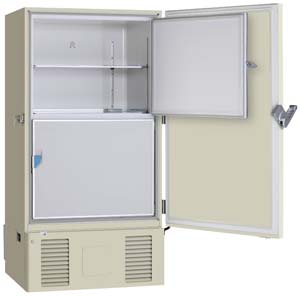
The upright 728l model is ideal for valuable research or clinical samples
Sanyo has expanded its range of dual-cooling -86°C freezers with the launch of the extra-large capacity MDF-U700VX, an upright 728 litre model which provides maximum sample security for valuable research or clinical samples.
With two independent refrigeration systems the dual-cooling freezers maintain a reliable and uniform -86°C ultralow temperature environment. Should one cooling system suffer an unexpected failure, the other circuit will keep irreplaceable samples safely around -70°C until service can be arranged. This freezer design not only protects precious samples but also prevents the inconvenience and expense of out-of-hours call-outs in the event of a failure of one of the refrigeration systems.
The MDF-U700VX has an extra-large capacity of 728 litres without taking up extra space, thanks to its VIP Plus high efficiency vacuum insulation. In addition to reducing energy use, VIP Plus provides typically 24% more storage capacity compared with a conventionally insulated freezer with the same footprint.
This latest dual-cooling unit offers Sanyo’s industry-first intelligent ECO Mode, optimising compressor operation to match the freezer’s running conditions and minimise energy use. Efficient long-term operation of the freezer is facilitated by the filter-less condenser design, which eliminates the need for routine filter cleaning.
The central door-mounted LCD display panel provides intuitive programming of set points and clear confirmation of freezer status. An on-board data logging function allows the operator to easily check recent freezer performance. Other user-friendly design features include comprehensive alarms, a vacuum release port for smooth door opening, and quiet operation.
The MDF-U700VX is certified as a Class IIa Medical Device (93/42/EEC and 2007/47/EC).