
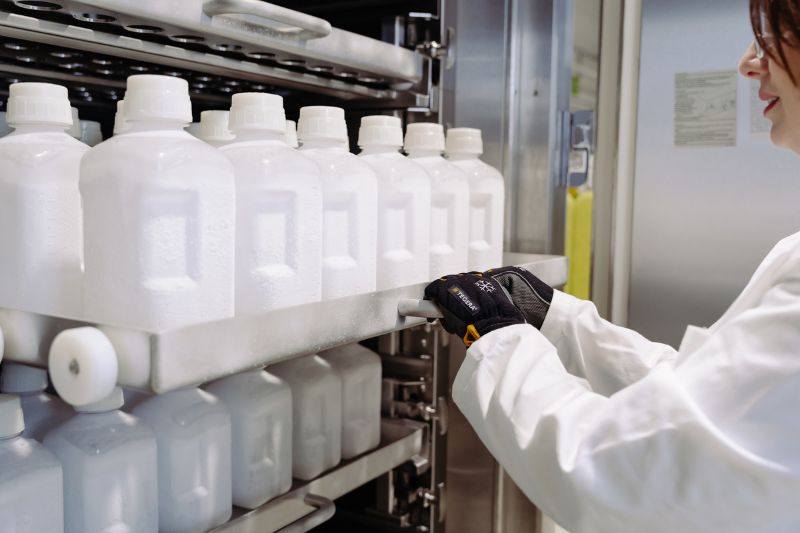
Single Use Support has announced the launch of RoSS.BLST, a new blast freezing and thawing platform designed to deliver maximum process consistency and product quality for high-value biologics.
The upgraded system features enhanced performance, increased capacity and recipe-driven freezing protocols down to -80 °C.
Cold chain management is one of the most critical steps in bioprocessing, as non-uniform or inefficient freezing can compromise drug substance integrity.
Single Use Support said that the new RoSS.BLST will mitigate these risks with fully 21 CFR Part 11 compliant, recipe-driven freezing protocols, helping to minimise batch-to-batch variability.
Advanced airflow management circulates air completely every 2.5 seconds, ensuring rapid and uniform temperature distribution.
This efficient direct cooling system, paired with a Siemens control system, accelerates pull-down to target temperature and shortens overall runtime, which the firm states will enable faster batch freezing cycles with lower energy demand.
RoSS.BLST is also designed for high-volume loading, supporting up to 192 × 2 L bottles per batch.
"With our next-gen RoSS.BLST, we’re transforming the freezing of bulk-packaged drug substances into an efficient, reproducible and scalable process," said Markus Fürhapter, CTO of Single Use Support.
Fully controlled freeze-thaw cycles translate into consistent process reliability, without added complexity.
Beyond freezing performance, the RoSS.BLST platform has been designed to maximise capacity within existing bioprocessing facilities.
According to Single Use Support, the system offers a high "usable chamber volume-to-footprint ratio," delivering up to 30% greater usable chamber capacity than comparable blast freezer technologies.
The blast freezer features a hygienic stainless-steel construction to support cleaning and maintenance requirements in regulated manufacturing environments.
The firm also added that the system aligns with industry sustainability goals by using natural refrigerants that have a lower environmental impact than conventional alternatives.
Integrated cold chain platform
RoSS.BLST forms part of Single Use Support's broader cold chain portfolio, which includes the RoSS.ULTF ultra-low temperature storage freezer range and secondary packaging solutions for single-use bottles and 2D bioprocess containers.
The company says the integrated platform is designed to support drug substance handling across multiple stages of the cold chain, including filling, freezing, long-term storage and transportation, with the aim of maintaining product integrity throughout the process.
Speaking exclusively to Manufacturing Chemist, Fürhapter explained how the new platform is designed to help CDMOs increase freezing capacity while making more efficient use of existing production space.
"With ~30% more usable chamber capacity in a comparable footprint, RoSS.BLST allows CDMOs to increase batch-freezing throughput without expanding cleanroom space or adding additional units."
In practice, this translates into higher output per installed system and improved facility utilisation, which is particularly valuable in space-constrained GMP environments.
"Modular interior options for a wide range of bioprocessing containers further enhance the aspects of maximising chamber utilisation and processing efficiency."
He added that though the new product had been designed to integrate easily with the RoSS.ULTF and secondary packaging solutions, it was also "fully compatible as a standalone upgrade within existing cold chain setups."
The company expects customers to adopt the technology in different ways depending on their operational requirements.
"Some customers will implement the full ecosystem for end-to-end efficiency gains, while others will leverage RoSS.BLST as a targeted upgrade to increase capacity and performance of their current processes."
Fürhapter noted that this flexibility allows organisations to either build a fully integrated freezing and cold-chain workflow or enhance specific stages of their existing operations without having to undertake a complete infrastructure overhaul.


