While borosilicate vessels, magnetic stirring, and vacuum filtration support early process development, they do not always capture the mechanical and thermal realities of industrial systems. Laboratory-scale setups, while effective for early development, can mask the physical complexities that emerge during scale-up, where agitation, heat transfer, and filtration behave differently in production environments. This leads not just to variation, but to failure to reproduce performance altogether.
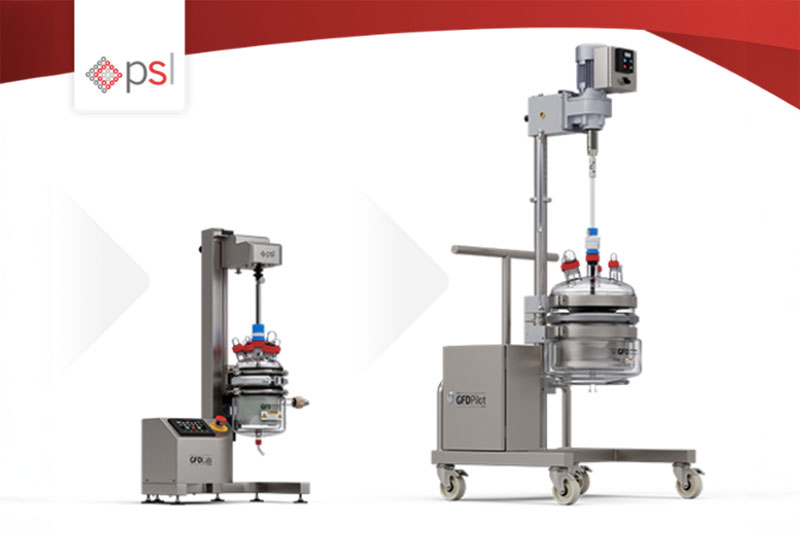
Powder Systems Limited (PSL) confronts this challenge directly through GFD technologies, with the GFD Lab and GFD Pilot nutsche filter dryers, aligning process development with real manufacturing conditions from the start.
1. Agitator Geometry and Shear Forces
One of the most overlooked process development mistakes is assuming that standard laboratory stirrers can replicate industrial agitation at scale. In reality, they cannot reproduce the ploughing and smoothing of an agitator within a full size agitated nutsche filter dryer (ANFD) because they lack the geometry, torque, and directional force required to mobilise and condition the filter cake. This limitation leads to:
- Inconsistent crystal size distribution
- Non-uniform filter cake formation
- Poor drying performance.
The Solution
With the GFD Lab, agitation becomes measurable instead of assumed. Its bidirectional, height-adjustable agitator allows engineers to explore how shear and compression influence a material during process development. These insights can then be carried forward into the GFD Pilot to replicate and refine process behaviour at a larger scale, maintaining the same agitation and material handling principles.
2. Inaccurate Heat Transfer Modelling
Another common process development error is relying on thermal behaviour observed in small glass vessels to estimate how processes will behave at scale. High surface-area-to-volume ratios exaggerate heat transfer efficiency, masking the thermal lag present in larger systems under full-scale conditions. The consequences are often immediate during scale-up:
- Overheating of sensitive compounds
- Extended drying cycles
- Inefficient energy usage
The Solution
Featuring a jacketed design, the GFD Lab ensures engineers can observe realistic heating and cooling behaviour of the material during processing. Thermal data gathered here provides a reliable reference point for transition into the GFD Pilot, supporting consistent, long-term performance as processes move to larger systems.
3. Overlooking Filter Cake Compressibility
Filtration behaviour at laboratory scale rarely reflects industrial conditions, particularly during scale-up. Büchner funnels do not account for pressure-driven filtration or the interaction between cake structure and industrial filter media, a process development mistake that often results in:
- Reduced filtration rates
- Filter cloth blinding
- Lower throughput
The Solution
The GFD Pilot generates a filtration environment that mirrors real process conditions, and thus can avoid the scale-up failures associated with inaccurate filtration. Engineers can evaluate how pressure, media, and cake structure interact, replacing theoretical predictions with measurable performance data before full-scale production.
4. Material-Product Interactions (The “Sticking” Factor)
Glassware is chemically inert, but production equipment is not. A critical oversight in process development is ignoring how products interact with metallic surfaces during scale-up. When compounds encounter materials like 316L stainless steel, challenges may include:
- Product adhesion
- Surface fouling
- Corrosion risks
The Solution
Engineers can use the GFD range to work with both glass and metallic vessels throughout process development. This makes it possible to identify compatibility issues early, avoiding yield loss or cleaning challenges later in scale-up.
5. Yield Loss During Manual Product Transfer
Separating filtration and drying steps introduces variability in process development and scale-up. Transferring wet cake between filtration and drying units exposes the product to environmental conditions and mechanical loss. Such a mistake can cause:
- Inaccurate yield calculations
- Increased contamination risk
- Reduced batch consistency
The Solution
Filtration, washing, and drying remain within the GFD Pilot, as a single enclosed system. Consequently, it can reduce handling and provide more accurate insight into yield and product behaviour at scale, enabling more cost effective manufacturing processes.
6. Delayed Containment Strategy for HPAPIs
Containment is often considered late in process development, which produces challenges when scaling highly potent active pharmaceutical ingredients (HPAPIs). Delayed planning can result in:
- Facility redesigns
- Increased operational costs
- Compromised operator safety
The Solution
PSL integrates containment into the GFD range through systems such as the GFD FilterBox, ensuring it is considered early rather than retrofitted as processes scale.
7. Lack of Scalable “Process Recipes”
Many process development mistakes stem from insufficient data capture, where qualitative instructions like mixing times or drying observations fail to capture the parameters that govern process performance. Without quantitative data, variability increases, reproducibility declines, and scale-up becomes unreliable.
The outcomes of inadequate data capture include:
- Rework during tech transfer
- Inconsistent batch
- performance
- Extended development timelines
The Solution
The GFD Lab PLUS enables automated data capture of torque, temperature, and pressure, generating a defined process dataset that can be transferred directly to the GFD Pilot, supporting consistent and repeatable process transfer.
Delivering Consistency Across Process Development and Scale-Up
Process development mistakes accumulate when laboratory methods fail to represent industrial reality, introducing uncertainty that only becomes visible during scale-up. Powder Systems Limited offers GFD systems that enable filtration, washing, agitation, and drying to be developed under representative conditions, allowing process behaviour to be characterised and transferred reliably. Reach out to PSL now to find out more about the GFD®Lab and GFD®Pilot filter dryer range and develop a production-ready process that performs consistently from laboratory to full-scale operation.