
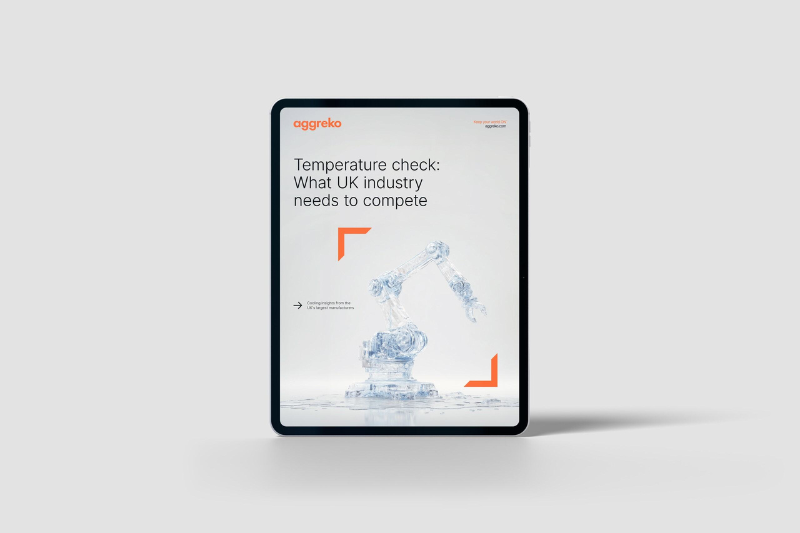
UK pharmaceutical manufacturers are under mounting pressure to comply with tightening F-Gas legislation, with ageing cooling infrastructure, rising costs and knowledge gaps emerging as the primary obstacles to timely upgrades, according to a new whitepaper from temperature control specialist Aggreko.
The report, titled "Temperature Check: What Does UK Industry Need to Compete?," surveyed 334 manufacturing plant managers at UK companies with a turnover of at least £50m.
Its findings paint a rather stark picture: 94% of respondents said F-Gas legislation will moderately or majorly impact their ability to maintain and upgrade cooling equipment, while 97% are already facing challenges in upgrading systems to meet stricter environmental regulations.
The F-Gas phase-down is now entering a critical stage. Currently, the UK is targeting a 98.6% reduction in hydrofluorocarbon (HFC) use by 2048 compared to 2015 levels, in support of its Net Zero commitments.
Although no new product bans or changes to leak-checking and recovery requirements are currently proposed, an accelerated reduction timeline is expected to significantly affect the availability of refrigerants with a Global Warming Potential (GWP) above 1000, making the transition to low-GWP alternatives increasingly urgent for pharmaceutical facilities planning new installations.
For pharmaceutical manufacturing specifically, cooling is central to product integrity, process stability and regulatory compliance, making it more than just a peripheral concern.
Yet the survey reveals that many sites are operating with equipment that is both environmentally non-compliant and increasingly prone to failure, creating a compounding operational risk.
Chris Smith, Head of Temperature Control, Aggreko UK, said manufacturers were caught between two competing pressures.
 "On one hand, they're working with ageing cooling equipment that is increasingly prone to failure, but on the other, they're being asked to meet increasingly rigorous environmental legislation," he said, adding that site managers need greater support and clarity to implement changes effectively.
"We are acutely aware of these challenges and commissioned Temperate Check to further analyse an often-overlooked area of the production process."
"In this, the impact of F-gas legislation stood out as a major talking point."
The F-gas timeline is entering a decisive phase in which sharper and faster reductions could be required and site decision-makers require greater clarity [around] equipment compliance if they are to transition in good order.
The report identifies three principal barriers to compliance: limited knowledge and understanding of current and forthcoming F-Gas regulations, a shortage of viable alternative solutions and the prohibitive cost of new compliant equipment.
These challenges are further compounded by volatile market conditions and the growing operational risks posed by extreme weather events, placing additional strain on cooling systems.
Practical solutions
Aggreko is urging pharmaceutical manufacturers to engage with the supply chain at the earliest opportunity and to explore alternative procurement strategies as a route to compliance.
The report highlights temporary cooling systems as a practical option, enabling sites to trial different equipment configurations without capital expenditure constraints and providing flexibility to manage seasonal peaks in production demand.
"Ageing equipment, higher operating temperatures and regulatory flux are converging to create a difficult situation that plant managers may not have the budget to adequately respond to," Smith said.
With the right support, businesses can access efficient, scalable cooling systems that meet today's demands without hitting the balance sheet.


