
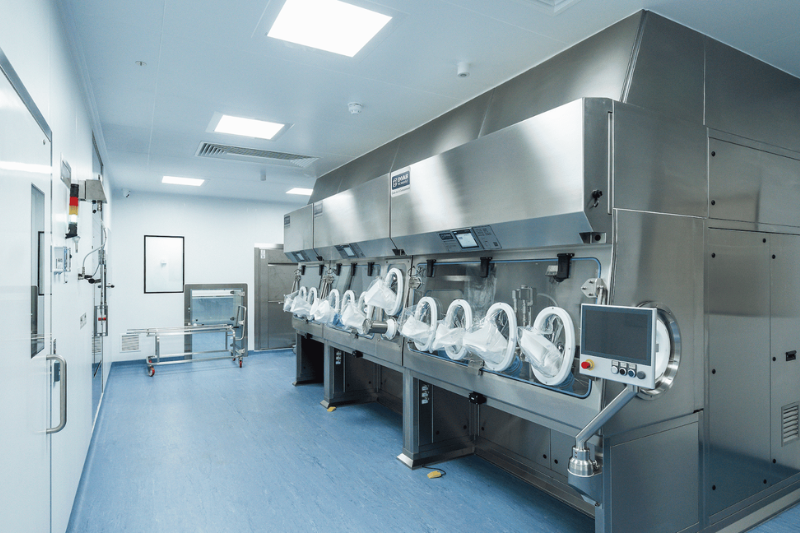
The CDMO Upperton Pharma has applied to the UK Medicines and Healthcare Products Regulatory Agency (MHRA) for approval of its 7000 sqft sterile manufacturing facility.
This follows successful validation batches of aseptic process simulation (APS) in line with the updated EU GMP Annex 1 (2023) standards.
The facility, designed according to current Eudralex Volume 4 Annex 1 standards and featuring advanced containment strategies, complements the existing 50,000 sqft development and manufacturing site in Nottingham, UK.
It will facilitate formulation development and production of aseptic and terminally sterilised drugs for parenteral, nasal and pulmonary delivery.
It supports small and medium biotech and pharmaceutical companies from pre-clinical to Phase II, offering formulation development, clinical manufacturing and analytical testing, with initial batches of up to 2000 units.
Nikki Whitfield, CEO at Upperton, said: "The team has worked tirelessly to achieve this outcome, particularly given the challenging landscape shaped by the updated Annex 1 guidelines."
Everyone involved, across every department, has contributed to building an outstanding sterile manufacturing capability that meets the highest global standards. We are extremely proud of what has been achieved.
The facility's construction, validation and commissioning all conform to revised EU GMP Annex 1 standards, emphasising higher hygienic design and stricter contamination control.
It includes two Grade C cleanrooms, an Envair VHP isolator, a LAST dry heat steriliser and an LTE autoclave for sterilisation.
The facility also features aseptic filling from Flexicon, advanced HVAC systems and PUPSIT for integrity testing.
Jon Austwick, Director of Quality & Compliance, added: "The facility has been built with a Quality by Design approach, embedding the highest contamination control strategies throughout."
Upperton, which is among the first UK CDMOs to develop a facility complying with the new Annex 1 contamination control standards, responded to the revised regulations by investing in state-of-the-art design and new aseptic processes, including contamination control, sterilisation workflows, environmental monitoring and operator training.
The £7m facility aims to address the bottleneck in small-scale aseptic manufacturing, easing delays for emerging biopharma companies by providing flexible, responsive options for early-phase clinical projects.
Whitfield added: "We want to give small and mid-sized biotech companies faster access to the high-quality sterile formulation development and manufacturing capacity they need to progress into clinical trials without unnecessary delays."
"This facility is a major part of that commitment."
Alongside its sterile filling capabilities, the new facility features a dedicated Grade C cleanroom designed to accommodate a second isolator for future aseptic spray drying, further building on Upperton’s longstanding expertise in spray-dried particle engineering to support sterile dry powder development and manufacturing, expected in Q4 2026.


