
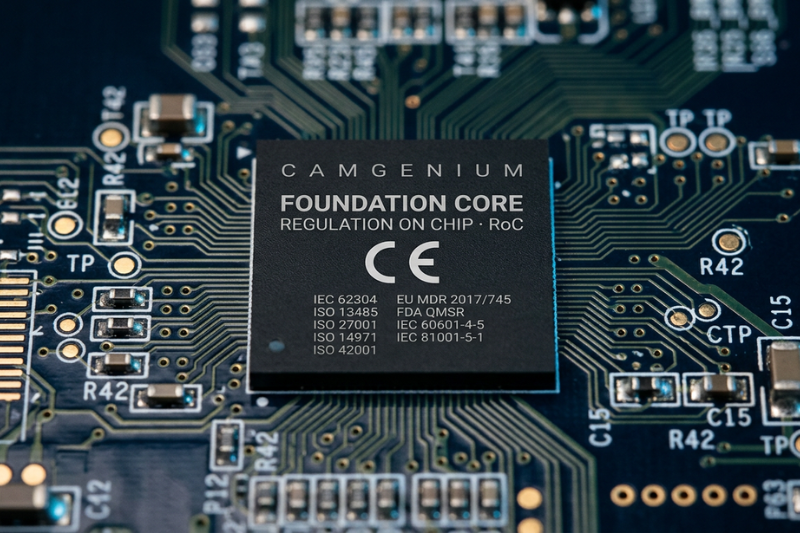
Camgenium has launched its new Foundation Platform, a pre-certified infrastructure package spanning firmware, cloud and compliance for connected medical device manufacturers.
The new platform combines pre-certified firmware, cloud infrastructure and compliance reporting, which the company says will help connected medical device manufacturers accelerate development by outsourcing much of the cybersecurity, connectivity and regulatory infrastructure required for market approval.
Building a connected medical device involves tackling two major engineering challenges simultaneously — the medical innovation itself and the technical and regulatory infrastructure required to make it secure, connect and compliant with medical regulations.
Starting from scratch is often slow and costly, requiring specialised expertise in firmware security, cloud infrastructure, regulatory affairs and quality management.
Before any clinical code can be written, teams must invest years in developing essential infrastructure, including secure boot processes, hardware-backed encryption, key management, over-the-air firmware updates and audit-grade logging.
Furthermore, these systems need to meet regulatory requirements from the very start, with integrated documentation throughout the design process.
Camgenium says that the new Foundation platform will address this through a complete, pre-certified infrastructure spanning the full hardware and software stack.
The platform combines Foundation Core, a Regulation on Chip (RoC) firmware that runs on a specific chip made by Nordic Semiconductor.
The firmware delivers IEC 62304-compliant communications, audit-grade logging, secure boot, encrypted over-the-air firmware updates and independent safety monitoring.
All clinical codes, algorithms and domain-specific innovations, the company says, will remain the customer's intellectual property.
Camgenium is also providing a hosted cloud environment, Foundation Cloud, which is developed to IEC 62304 Class B medical device software standards and operated in accordance with ISO 27001.
The firm added that it is compliant with NHS DSPT, HIPAA, SOC 1, SOC 2, GDPR and Cyber Essentials.
Foundation Reporting completes the compliance picture by generating twelve categories of regulatory reports, automatically and continuously covering device integrity, risk control status to ISO 14971:2019, software bill of materials (SPDX 2.3), AI model governance to ISO 42001:2023, fleet security and cloud infrastructure compliance.
Evidence that would otherwise require sustained effort across regulatory affairs, cybersecurity, firmware engineering and machine learning specialisms is instead generated from live system telemetry, without the need for manual data entry or retrospective documentation.
The platform is continuously maintained in accordance with the requirements of IEC 62304:2006+AMD1:2015, ISO 13485:2016, ISO 27001:2022, IEC 60601-4-5:2021, IEC 81001-5-1, EU MDR 2017/745, FDA QMSR and UKCA.
"Foundation Core packages the regulatory infrastructure that every connected medical device needs — secure boot, compliant communications, audit-grade logging — into a single Nordic chip, certified once and reused many times,” said Dr Philip Gaffney OBE, CEO of Camgenium.
The customer’s application talks to Foundation Core using SPI. From their perspective, they are acquiring a compliant communications component, not undertaking a regulatory programme.
Camgenium added that early versions of the Foundation Platform have already been supplied to the Cambridge University Department of Engineering during the past six years, where final-year students use the platform on Nordic development kits for degree-counted medical device projects.
The platform will be available to connected medical device manufacturers under a long-term Software-as-a-Service (SaaS) partnership model, with pricing structured per active device under management and inclusive of connectivity, all twelve report types, software maintenance, security patches and regulatory alignment updates.


