

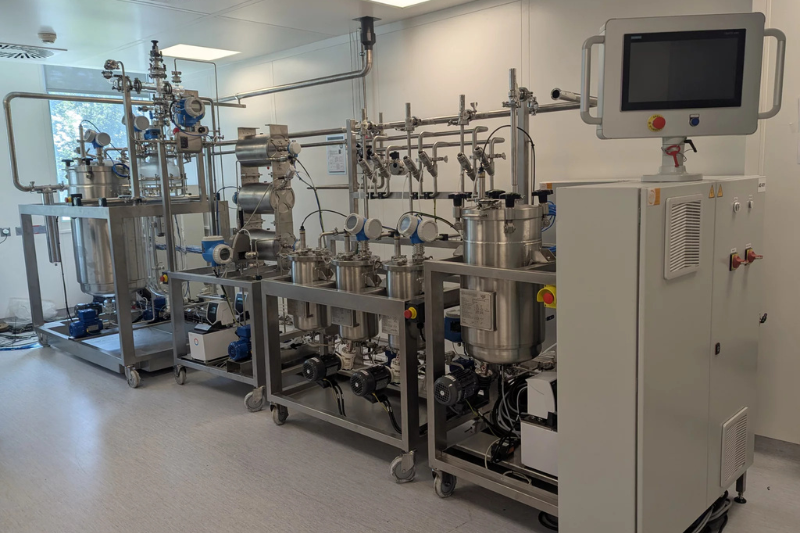
A European consortium has announced the validation of a continuous manufacturing platform for APIs, demonstrating an approach designed to improve manufacturing flexibility, process control and pharmaceutical supply-chain resilience.
The PIPAC consortium – made up of De Dietrich, Alysophil, Bruker and Novalix – validated the platform through the continuous-flow production of fentanyl, a highly potent and tightly regulated pharmaceutical API.
The demonstration is intended to show that the technology can operate under challenging manufacturing conditions and provide a foundation for producing other pharmaceutical ingredients.
The platform integrates continuous-flow chemistry with real-time analytical monitoring and AI-driven process control.
Rather than relying on conventional batch manufacturing, the system continuously monitors production and can adjust critical process parameters in response to incoming data.
According to the consortium, this could reduce some of the risks associated with traditional scale-up, where processes must be transferred from laboratory or pilot scale to increasingly large batch production systems.
Integrating synthesis, analytics and control
Novalix stated that it had developed the continuous-flow synthesis route, while Bruker has provided analytical technologies for real-time process monitoring.
Alysophil has contributed its AlchemDrive autonomous AI process-control platform, which analyses production data and adjusts manufacturing parameters during operation.
De Dietrich developed the industrial hardware and automation architecture, integrating the synthesis, analytical and control components into a platform designed for future industrial deployment.
The consortium said the approach could ultimately support smaller and more modular production units, potentially enabling pharmaceutical manufacturing to be located closer to regional markets and reducing reliance on highly concentrated API supply chains.
The technology could also be expanded to incorporate downstream operations such as filtration, purification and drying, creating a potential pathway towards more integrated continuous pharmaceutical manufacturing.
The development comes amid continued efforts by pharma manufacturers and governments to strengthen API supply chains, following disruptions, geopolitical uncertainty and concerns around the geographic concentration of API production.
The consortium said the successful demonstrator provides a foundation for future GMP-compatible systems, with continuous manufacturing potentially allowing production capacity to be increased through longer or parallel operation rather than conventional batch scale-up.
Frédéric Guichard, Group Executive Director, De Dietrich commented: "For decades, pharmaceutical manufacturing has relied on production models that were designed for a different era."
Today, the industry faces new challenges: supply-chain resilience, production sovereignty, faster industrialisation and greater flexibility.
PIPAc demonstrates that it is possible to rethink how pharmaceutical ingredients are manufactured. By combining continuous production, real-time analytics and intelligent process control, we have created a platform that has the potential to transform how critical medicines are produced in the future."
For pharma manufacturers, the model could offer a route towards more flexible API production while combining process intensification, automated control and real-time quality monitoring within a single manufacturing platform.


