
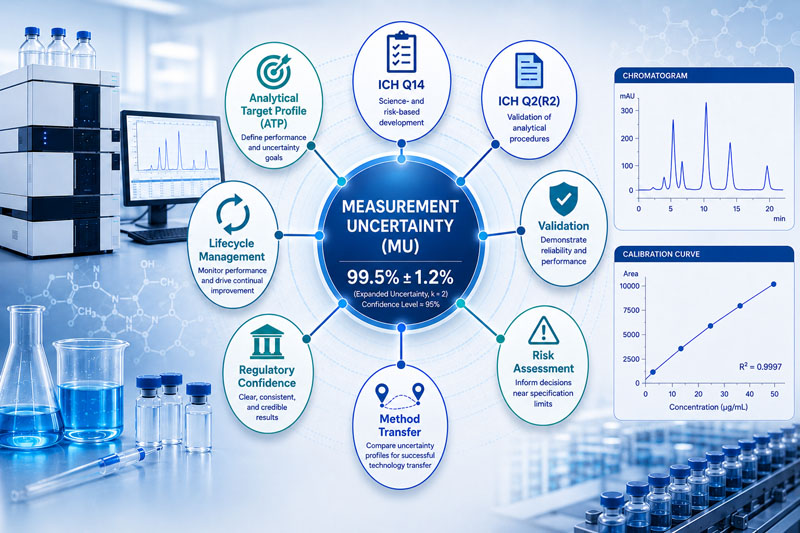
Frank Judge, Consultant Chemist at Butterworth Laboratories, explores how that principle can improve development, validation, transfer and lifecycle control.
ICH Q14, Analytical Procedure Development, adopted in 2023, represents a significant advance in the application of science- and risk-based principles to analytical procedure development in the pharmaceutical industry.

Published alongside ICH Q2(R2), Validation of Analytical Procedures, it promotes analytical target profiles (ATPs), quality by design (QbD) principles, enhanced development approaches, robustness evaluation and lifecycle management for analytical procedures.
Although Q14 and Q2(R2) provide a comprehensive framework for analytical development and validation, they do not explicitly position measurement uncertainty (MU) as a routine quantitative expression of confidence in reported analytical results.
This creates a practical gap: analytical procedures may satisfy individual validation characteristics while still leaving uncertainty about the reliability of the final reported value, particularly when results are close to specification limits or are used to support high-impact regulatory decisions.
MU is an established metrological concept embedded in ISO/IEC 17025, which requires laboratories to evaluate significant “uncertainty contributors” and report uncertainty when it affects the validity or interpretation of results.
Integrating MU into Q14 would strengthen analytical target setting, risk assessment, lifecycle monitoring, method transfer and regulatory confidence by providing a practical quantitative expression of confidence in analytical results.
Regulatory context: QbD and the ICH quality framework
ICH Q14 and Q2(R2) extend Quality by Design principles into analytical procedure development and validation.
Their emphasis on science-based development, risk management, robustness, and lifecycle control creates a natural place for MU: analytical performance should be expressed not only through individual validation characteristics but also through an integrated estimate of confidence in the reported result.
Understanding measurement uncertainty
Every analytical measurement contains variability from sources such as instrument performance, analyst technique, sample preparation, environmental conditions, calibration standards and statistical variation.
Traditional validation parameters assess individual aspects of performance, but they do not provide a single quantitative estimate of the uncertainty associated with the final reported result.
Measurement uncertainty combines the effects of these contributing factors into a unified estimate, allowing laboratories to express analytical results in the form: Measured Value ± Expanded Uncertainty.
For example, an assay result reported as 99.5%±1.2% at a specified confidence level communicates both the measured value and the confidence that should be attached to it.
This is especially important for batch release, stability conclusions, comparability assessments and regulatory commitments.
Alignment with the scientific principles of ICH Q14
Q14 encourages science-based decision-making during analytical procedure development. MU supports this objective by converting multiple sources of analytical variability into a quantitative assessment of confidence.

Two methods may meet the same accuracy and precision criteria yet differ materially in overall uncertainty because of calibration instability, environmental sensitivity or sample preparation variability.
Incorporating MU would therefore help developers to select the method that provides the greatest confidence in routine use.
Strengthening the analytical target profile
The analytical target profile (ATP) defines what an analytical procedure must deliver and the performance needed to support the intended decision.
It is therefore an appropriate place to define acceptable uncertainty limits for critical measurements.
Instead of relying only on separate validation parameters, an ATP could specify a maximum allowable expanded uncertainty.
For example: “The analytical procedure shall quantify the active pharmaceutical ingredient content with an expanded uncertainty not exceeding ±2.0% at a 95% confidence level.”
This would make ATPs more measurable, decision-focused and aligned with patient safety objectives.
Improving risk-based decision-making and specifications
Risk management is central to modern pharmaceutical quality systems and to Q14.

MU strengthens risk assessment by quantifying how far a reported result may reasonably differ from the true value, allowing this information to inform acceptance criteria, control strategies and decision rules.
For example, with an assay specification of 98.0–102.0%, a result of 98.2% may appear compliant as a single value. If the expanded uncertainty is ±1.5%, however, the true value could plausibly fall below the lower limit.
MU can therefore support guard bands, investigation thresholds and predefined decision rules, reducing hidden risks of false acceptance or false rejection.
Lifecycle monitoring and continual improvement
Q14 promotes lifecycle management after validation. MU provides a useful lifecycle metric because changes in uncertainty over time may indicate deteriorating method performance before out-of-specification results occur.
Better Integration with Q2(R2)
Q14 and Q2(R2) are complementary: Q14 addresses analytical development whereas Q2(R2) addresses validation.
MU would connect the two by integrating validation data on accuracy, precision, intermediate precision, reproducibility and robustness into a single assessment of analytical capability.
Regulatory review, harmonisation and specifications
For regulators, MU provides a clearer view of the confidence associated with submitted analytical results. This can improve consistency when assessing method suitability, specification compliance, comparability studies, stability data, and observed trends.

At the same time, explicit use of MU would support global harmonisation by aligning pharmaceutical analytical practice more closely with internationally accepted metrological principles, including those used by ISO/IEC 17025-accredited laboratories.
It would also improve specification setting by helping to distinguish product versus analytical variability and by reducing the risk of false acceptance or false rejection decisions.
Method transfer and comparison
Method transfer remains a common challenge because procedures that perform well in one laboratory may behave differently at another site.
Comparing uncertainty profiles, rather than only mean results or precision estimates, gives laboratories a more complete basis for judging transfer success and identifying hidden sources of variability.
Innovation and patient safety
Advanced analytical technologies such as process analytical technology, spectroscopy, real-time release testing, and automated systems often involve complex models and multiple sources of variability.

MU provides a framework for expressing these sources in a single estimate, supporting regulatory acceptance of innovative technologies. The same principle supports patient protection.
When uncertainty is understood and controlled, there is less risk of releasing substandard product, rejecting acceptable product, misinterpreting stability trends or overlooking quality defects.
Implementation challenges and a practical adoption pathway
Implementation would require additional training, statistical capability, consistent calculation approaches and industry standardisation.
These challenges are real but manageable if MU is introduced proportionately. A phased model is the most realistic route.
Organisations could begin with high-risk or high-impact procedures, including potency assays, impurity methods with tight limits, batch-release methods, stability-indicating procedures, method transfers and advanced analytical technologies.
As experience develops, uncertainty estimates could be incorporated into ATPs, validation reports, lifecycle monitoring plans and regulatory submissions where they add clear decision value.
Conclusion
Adopting measurement uncertainty within Q14 would advance pharmaceutical analytical science by providing the quantitative confidence metric needed to support science- and risk-based decisions.
As regulation moves toward risk-based and lifecycle-oriented approaches, explicit consideration of MU would be a logical extension of Q14.
It would strengthen ATPs, improve decisions near specification limits, support lifecycle monitoring and transfer, and increase confidence in the analytical data used to ensure product quality and patient safety.