
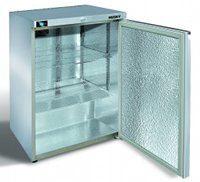
Husky’s vaccine refrigerator for GP and dental surgeries, hospitals, chemists and clinics is a precision engineered and high-spec unit built with a robust stainless steel outer and hermetically sealed hygienic ABS plastic interior, complete with rounded corners to aid cleaning.
A pre-set electronic temperature controller stores vaccines at 2°–8°C. The fridge also incorporates an audible door open alarm, failed temperature alarm, and a fail-safe secondary back-up digital display thermometer.
The vaccine refrigerator door includes security lock as standard, and the refrigerant used in manufacture is R600, an efficient hydrocarbon refrigerant coolant that is CFC-free and a natural non-greenhouse gas.
Husky is also planning the launch of a domestic model for secure storage at home, which will help keep medicines away from children and other products stored in a household refrigerator.
Husky keeps vaccines cool
Vaccine refrigerator has a stainless steel outer and hermetically sealed interior
You may also like

Trending Articles
You may also like
Manufacturing
![Step into cognitive manufacturing: Welcoming you to Booth S-1720]()

Step into cognitive manufacturing: Welcoming you to Booth S-1720
At Pack Expo 2026, IMA Group will showcase its latest innovations in processing, packaging, end-of-line, automation, as well as digital solutions and customer services across the Pharmaceutical, Med-Tech, Food, Personal Care, E-Commerce and Labeling industries

Manufacturing
![Patented device reinvents Solid Phase Extraction]()

Patented device reinvents Solid Phase Extraction
Biotech Fluidics announce SPEedy - a device that provides an effortless way to perform Solid Phase Extraction (SPE) sample preparation procedures without need of an external vacuum and compatible with any adsorption chemistry or eluent composition
Manufacturing
![Orano Med inaugurates Europe's first industrial-scale lead-212 radioligand therapy facility]()

Orano Med inaugurates Europe's first industrial-scale lead-212 radioligand therapy facility
The €29m ATLab site will target up to 10,000 doses annually and its two-hour proximity to major European airports meets the critical 24-hour production-to-administration window imposed by lead-212's 10.6-hour half-life

Manufacturing
![Catalent launches ten-month gene-to-drug substance programme for complex biologics]()

Catalent launches ten-month gene-to-drug substance programme for complex biologics
The accelerated pathway extends the CDMO's Rapid Antibody framework to bispecifics and next-generation formats — targeting master cell bank release by month seven and bulk drug substance lot release by month ten