

When tablet weight variability shows up late, the damage is usually already done. By that point, time has been lost, material has been consumed, investigations have started, and confidence in the process has already taken a hit.
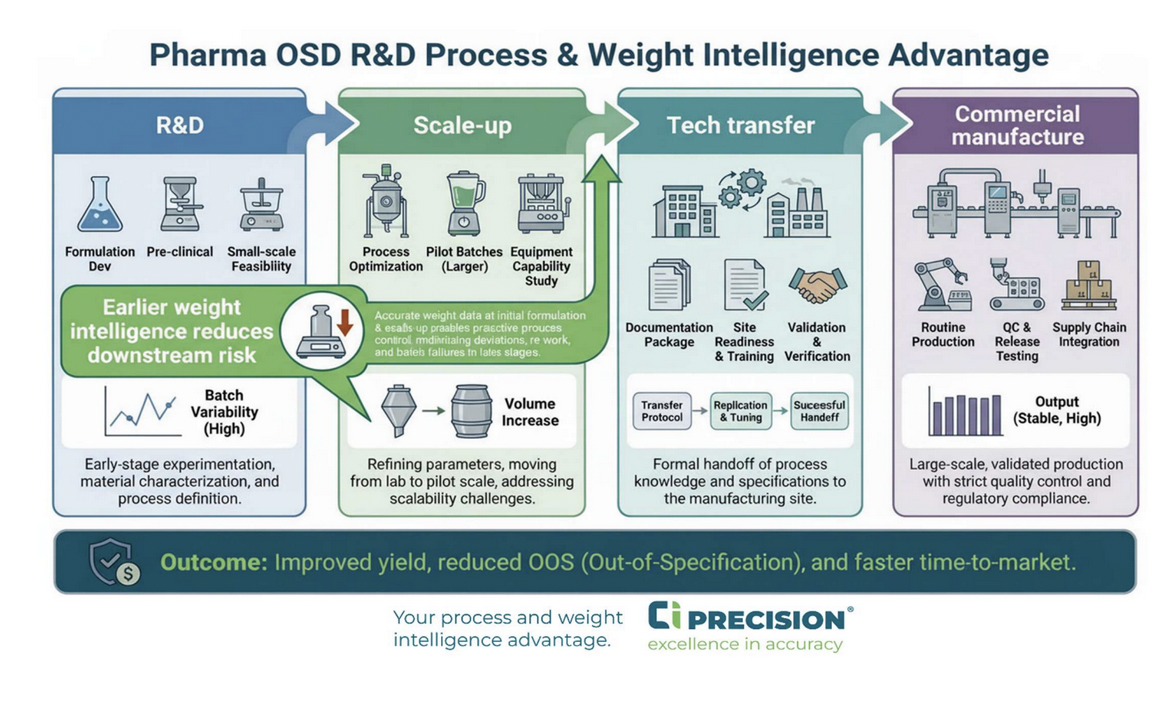
That is why I believe weight sorting needs to move upstream.
Too often, weight sorting is viewed as something that happens near the end: a final check, a containment step, a way to separate good product from bad product.
That view is too narrow.
In reality, weight sorting can do far more than identify rejects. Used properly, it can help OSD teams understand process behaviour earlier, make faster decisions, reduce risk at scale-up, and build more confidence before commercial manufacture begins.
For R&D, tech transfer, and production teams alike, that matters.
- Weight is not just an output. It is an early warning signal.
Tablet or capsule weight is one of the most accessible indicators of process consistency. It reflects what is happening upstream.
When weight starts to drift, widen, or behave unpredictably, it often points to deeper issues such as:
-
blend inconsistency
-
poor flow
-
feeder instability
-
compression variability
-
equipment set-up limits
-
environmental influence
That makes weight data more than a final quality check.
It makes it a practical operating signal.
The sooner teams can see that signal clearly, the sooner they can act on it. That is especially important in development, where small process weaknesses can hide behind acceptable averages until they become much more expensive to fix.
-
Earlier weight sorting creates faster learning cycles.
One of the biggest pressures in OSD development is speed.
Teams are expected to move fast, reduce iteration, and make sound decisions with limited material and limited time. But speed without feedback is guesswork.
This is where earlier weight sorting has real value.
Instead of waiting until a later stage to assess consistency, teams can use high-resolution weight analysis and sorting to generate meaningful feedback during development batches.
That helps answer practical questions sooner:
-
Is the process centred?
-
Is variability tightening or widening?
-
Are adjustments improving the batch or simply moving the mean?
-
Is the formulation behaving consistently enough to support the next step?
Those are not abstract questions. They shape timelines, confidence, and next actions.
The teams that learn fastest are usually the teams that measure intelligently.
-
Sorting earlier reduces waste, rework, and avoidable delay.
Late discovery is expensive.
When weight-related issues are only picked up after more material, more labour, and more internal expectation have already been invested, the commercial cost is bigger than many people admit.
It is not just scrap.
It is:
-
repeated development activity
-
delayed scale-up
-
extra investigation time
-
avoidable use of scarce API
-
disruption to project momentum
That is why earlier intervention matters.
Weight sorting can help teams identify the boundary between acceptable and unstable product sooner. That means less time spent pushing questionable material forward and more time spent working with data that supports better decisions.
In a tighter market, with more pressure on efficiency and fewer resources to waste, that is not a nice-to-have. It is good operating discipline.
-
Better weight intelligence improves tech transfer.
This is the part that often gets overlooked.
A lot of frustration in tech transfer comes from the assumption that a process which looked acceptable in development is automatically robust enough for production.
Sometimes it is.
Sometimes it is simply unchallenged.
Weight behaviour can reveal whether the process is genuinely stable or only appears stable under a narrow set of conditions. If teams capture enough useful weight data earlier, they gain a clearer picture of:
-
process capability
-
sensitivity to change
-
likely scale-up behaviour
-
acceptable operating windows
-
where control needs to be tighter
That strengthens transfer.
Instead of handing over a process with unresolved variability hidden inside it, the receiving site gets a better-defined process with clearer evidence behind it.
That reduces friction between development and manufacturing. It also reduces the risk of unpleasant surprises once throughput, batch size, and operational complexity increase.
-
Modern weight sorting is about evidence, not just separation.
The real opportunity today is not only sorting. It is what the sorting data allows you to prove.
In regulated environments, evidence matters.
Teams need to show not only that they can detect non-conforming units, but that they understand the process, respond appropriately, and maintain control in a structured way.
That is where modern weight sorting solutions have become far more valuable than many people realise.
High-precision systems can support:
-
meaningful batch insight
-
rapid identification of variation
-
data-led process refinement
-
stronger decision support
-
clearer quality evidence
And when this is linked with better data handling, the value increases again.
It becomes easier to move away from fragmented records, delayed interpretation, and reactive investigation. Instead, teams can work from clearer, more immediate evidence.
Why this matters now
The pressure on OSD manufacturers and developers is only increasing.
Faster timelines. More scrutiny. Higher expectations. Less tolerance for ambiguity.
In that environment, companies that treat weight sorting as a strategic capability will gain an edge over those that still see it as a downstream clean-up step.
That does not mean every challenge can be solved by adding a sorter.
It does mean that the right weight sorting approach can help teams see process truth earlier.
And that changes the quality of the decisions that follow.
Where solutions like the SADE SP 60 Series fit
This is exactly where advanced weight sorting solutions earn their place.
When systems are capable of delivering high-resolution measurement, reliable separation, and practical operating performance, they become more than inspection tools. They become part of how teams build process understanding.
For OSD teams working with tablets and capsules, that can mean:
-
better insight during development
-
greater confidence before scale-up
-
more structured evidence for process understanding
-
reduced risk of carrying instability further downstream
That is a stronger conversation than simply talking about reject rates or throughput in isolation.
Because the real value is not just what gets removed.
It is what gets learned.
Final thought
The earlier you understand weight variation, the earlier you understand the process itself.
That is why I believe weight sorting belongs further upstream than many organisations currently place it.
Not as a last line of defence.
As an earlier source of intelligence.
And for OSD teams trying to move faster while reducing risk, that shift in mindset could make a very real difference.
What is your view?
Are you still seeing weight sorting used mainly as an end-stage control, or is it becoming part of earlier process understanding in your organisation? I would be interested to hear how others are approaching this in R&D, tech transfer, and production.