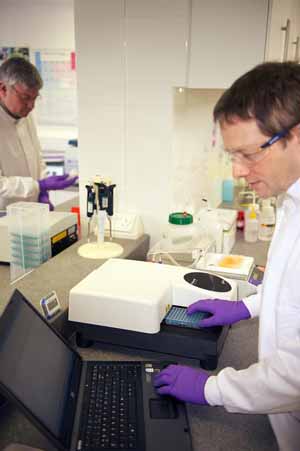
New generation of microplate readers
Biochrom has a new generation of microplate readers, tailored to meet the needs of modern labs
Lab workers can now benefit from the cost-effective and easy to use instrument. Offering flexibility and full performance with no redundant features, the filter-based, PC-controlled EZ Read 400 can be tailored to suit application requirements.
The ability to perform single or dual wavelength measurements to incorporate reference wavelength readings, and the option to do so at timed-intervals, means the EZ Read 400 is ideal for ELISA, protein, cell biology and kinetic assays.
Designed to take up the minimum of bench space, and incorporating ADAP Basic PC software and USB connections for easy instrument connection and data transfer, the new EZ Read 400 can be configured with a choice of filter options within a wavelength range of 400-750 nm , a choice of data analysis software packages and a QC plate for instrument validation.

You may also like
Trending Articles
You may also like
Manufacturing
The story of an East-West German company | 150 years of Romaco Kilian
Kilian’s story tells of the rise, fall and resurgence of a Berlin company steeped in tradition, which is now based in Cologne. It is the story of the entrepreneur Fritz Kilian, who turned a small locksmith’s workshop in Berlin into a successful company that is still a leading manufacturer of tablet presses today. It is the story of a visionary whose legacy has endured the test of time and continues to this day
Manufacturing
ystral expands India footprint with new Bangalore facility to support Asian markets
German mixing and process technology specialist ystral has opened a new facility in Bangalore, strengthening its Indian operations and laying the groundwork for a regional service hub supporting fast-growing Asian markets
Manufacturing
Why aseptic processing is critical for microsphere drug manufacturing
As microsphere-based drug delivery systems move from niche innovation to commercial reality, manufacturers face growing pressure to guarantee sterility without compromising product integrity. Aseptic processing has become essential to meeting both regulatory expectations and patient safety requirements