
Of interest in 2010: the Anthos 2010 microplate reader
Order before 30 June for free software upgrade
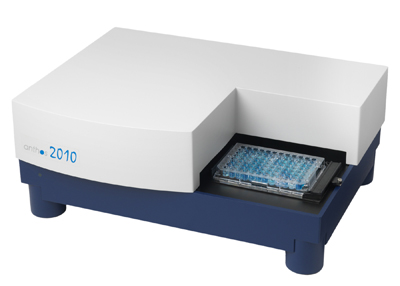
Four filters are supplied as standard that cover the wavelengths for most common absorbance assays with a colorimetric endpoint, e.g. ELISA, BCA, Bradford and Lowry assays, and additional filters are available.
A choice of software packages enables the user to connect to a PC and run both endpoint and kinetic assays with ease. Results can be printed directly or exported to a spreadsheet for further analysis.
Order the Biochrom Anthos 2010 instrument before the end of June 2010 and the user will receive a free software upgrade to program the plate layout with blanks, standards and controls. This permits the user to perform qualitative analysis on the results or quantify unknown samples using a standard curve eliminating outliers.
The Biochrom Anthos range of high performance microplate instrumentation is manufactured by Biochrom and available worldwide.
For complete specifications on the Biochrom Anthos microplate readers as well as the complete Biochrom product line go to www.Biochrom.co.uk
You may also like

Trending Articles
-
You need to be a subscriber to read this article.
Click here to find out more.
You may also like
Manufacturing
![Patented device reinvents Solid Phase Extraction]()

Patented device reinvents Solid Phase Extraction
Biotech Fluidics announce SPEedy - a device that provides an effortless way to perform Solid Phase Extraction (SPE) sample preparation procedures without need of an external vacuum and compatible with any adsorption chemistry or eluent composition
Manufacturing
![Orano Med inaugurates Europe's first industrial-scale lead-212 radioligand therapy facility]()

Orano Med inaugurates Europe's first industrial-scale lead-212 radioligand therapy facility
The €29m ATLab site will target up to 10,000 doses annually and its two-hour proximity to major European airports meets the critical 24-hour production-to-administration window imposed by lead-212's 10.6-hour half-life

Manufacturing
![Catalent launches ten-month gene-to-drug substance programme for complex biologics]()

Catalent launches ten-month gene-to-drug substance programme for complex biologics
The accelerated pathway extends the CDMO's Rapid Antibody framework to bispecifics and next-generation formats — targeting master cell bank release by month seven and bulk drug substance lot release by month ten
Design & Build
![Sterling Pharma Solutions doubles ADC manufacturing capacity at Deeside with new GMP suite]()

Sterling Pharma Solutions doubles ADC manufacturing capacity at Deeside with new GMP suite
The multi-million-pound expansion adds a 1400 sqft Grade C cleanroom, OEB5 containment handling and a 3400 sqft analytical laboratory — extending Sterling's bioconjugation capability from development through to Phase III and commercial scale
Manufacturing
![Piramal Pharma Solutions and NP2 to complete cyclophosphamide development phase next month]()

Piramal Pharma Solutions and NP2 to complete cyclophosphamide development phase next month
Piramal Pharma Solutions (“PPS”), a leading global Contract Development and Manufacturing Organisation (CDMO) and part of Piramal Pharma Ltd. (“PPL”) (NSE: PPLPHARMA | BSE: 543635), and its partner NP2, a nonprofit generic drug manufacturer, today announced their plans to finish the drug development phase of the generic cancer drug cyclophosphamide in October