On the way there, the first step is to minimise any harmful footprint that is being left and transform it into a positive, enduring handprint that serves the entire ecosystem (Figure 1)
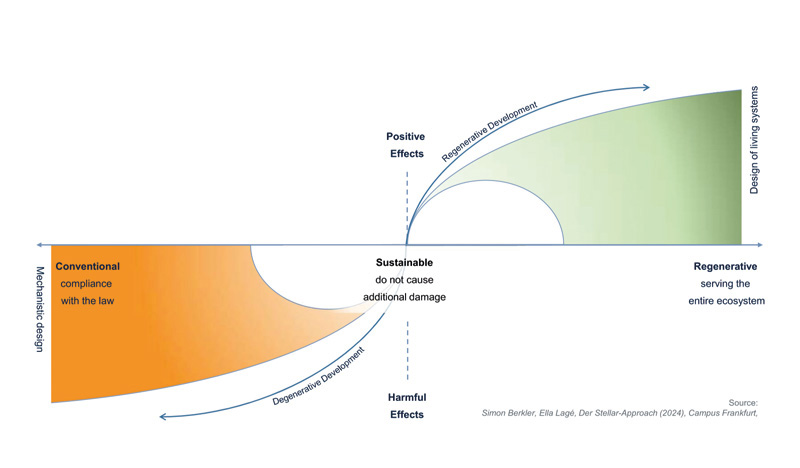
A regenerative economy not only aims to create a less harmful footprint, but also to have a positive impact on all life on Earth through all the actions it involves. (Source: Bürkert Fluid Control Systems)
No economy without society and no society without ecology
To make this more than simply a vision, the fluidics experts at Bürkert have assembled a global, interdisciplinary team that develops strategies at organisational level and enables and empowers employees to act regeneratively. To ensure that the strategies and measures meet holistic requirements, the team has based its work on the 17 Sustainable Development Goals (SDGs) of the United Nations. Each of the associated 169 sub-goals has been assessed from a double materiality perspective, and nine fields of action for the company have ultimately been derived from the results. One of the starting points, for example, is the Product Carbon Footprint (PCF). Throughout its entire life cycle, every product leaves a carbon footprint that covers everything from production and use to disposal. Making the values associated with this transparent not only satisfies the requirements already being expressed by some customers today, but also provides concrete indications of where leverage can be applied to improve regenerative actions.
Andrea Häußermann (Figure 2), Program Manager Sustainability at Bürkert, adds: “Sustainability is much more than the PCF or CCF (Corporate Carbon Footprint), however. It encompasses the economy, social issues and ecology – viewing them as three pillars that are intertwined rather than parallel. Ultimately, the economy cannot function without society and society can only function well in a healthy ecological setting. This leads to responsibility. Against this background, we develop our measures in a global, diverse team. What is important to us is a good mix of top-down and bottom-up solutions. We believe that we have to involve the people in the company in the process of achieving a regenerative economy, because they are the ones who make the changes.”
The first concrete steps
Many of the employees at the global locations and offices already have an intrinsic need to play a part in ensuring their company operates effectively over the long term. The various measures being undertaken will now give them more opportunity to fulfil this need. A whole range of projects have already been established, such as biodiversity projects at the company’s location in Triembach, France, which are having a tangible impact on the environment. In the UK, meanwhile, methodical efforts have been made to promote more reuse of packaging materials, and Bürkert’s India location has electrified all of its shared mobility options. Through its strategy, the company has also systematically defined decarbonisation projects whose aim is to replace the significant emissions being produced by the various locations. A location has been found and work is underway on one of the most effective measures currently available to the company: making the energy supply at its Campus Criesbach more electrified and more flexible.
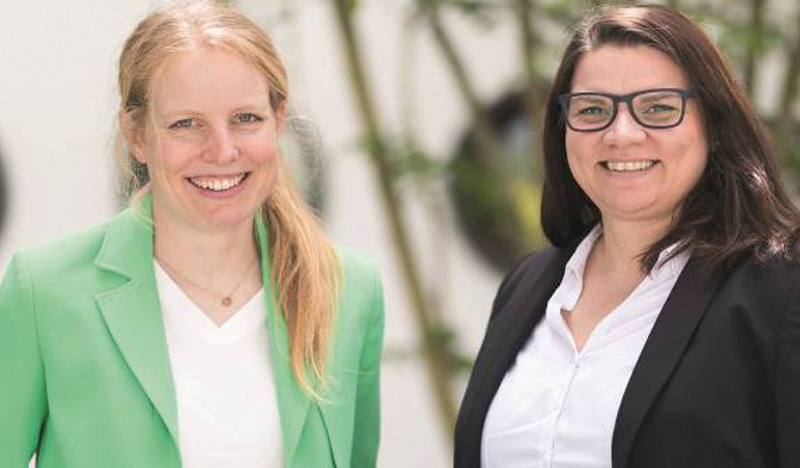
Dr Judith Richter and Andrea Häußermann, Program Managers Sustainability at Bürkert Fluid Control Systems. (Source: Bürkert Fluid Control Systems)
Dr Judith Richter, Program Manager Sustainability at Bürkert, adds: “Of course, we have to keep costs in mind at all times and prioritise measures based on how efficient they are. It is also important to consider that not all measures will pay off in the short term. For example, we have developed a comprehensive plan that will ensure sustained decarbonisation to the tune of 3,500 euros per tonne annually. This approach will probably pay off in the long term only – but when it does, it will pay off on a whole range of levels. We are already seeing our approaches to a regenerative economy pique the interest of various customers, for example. They are aware that our solutions in this area are not yet fully formed, but they appreciate that we want to work together to take steps in the right direction.”