
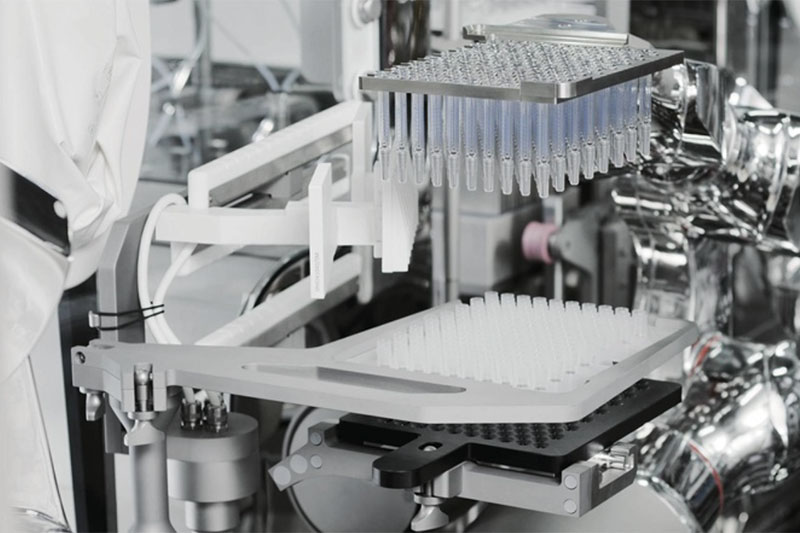
The sterile injectable market is evolving rapidly, driven by increasing demand for biologics, vaccines and innovative therapies, stricter regulatory requirements and the need for flexible, resilient manufacturing.
In line with the principles of Quality by Design and EU GMP Annex 1, modern aseptic manufacturing increasingly relies on advanced barrier technologies, automation, robust contamination control strategies and data-driven process management.
Aenova Latina, one of Europe’s leading CDMO sites, addresses these requirements with two state-of-the-art, fully automated sterile filling lines based on complementary barrier technologies. The dual-platform approach combines an Open Restricted Access Barrier System (oRABS) with an isolator-based filling line, providing operational redundancy, technological diversity and maximum flexibility for customer projects.
The F&F1 oRABS combo line is designed for high-speed, high-volume production and supports vials from 2R to 10R and pre-filled syringes (PFS) from 0.5 to 10 mL. Its rapid changeovers and operational flexibility make it particularly suitable for commercial campaigns and products that may be sensitive to residual vaporised hydrogen peroxide (VHP).
The F&F2 isolator combo line offers enhanced flexibility and scalability, supporting vials from 2R to 50R, PFS from 0.5 to 50 mL and cartridges from 1 to 20 mL. Configurable filling systems ranging from ten needles to single-needle operation enable efficient production from small clinical batches to large commercial campaigns.
Both lines can operate with single-use systems, stainless-steel equipment or hybrid configurations, facilitating efficient technology transfer and flexible manufacturing strategies.
The two technologies are considered complementary rather than competing solutions.
Technology selection is governed by the site-wide Contamination Control Strategy (CCS), integrating facility design, process controls, environmental monitoring, personnel qualification, cleaning and disinfection, APS/media fills and continuous quality oversight.
The oRABS platform offers advantages for products where VHP exposure could represent a degradation risk, while the isolator provides enhanced separation and containment for products compatible with VHP decontamination.
A key strength of Aenova Latina is its ability to support products throughout their lifecycle. The same facility can accommodate early clinical supply through commercial scale-up, different batch sizes and multiple presentations, including transitions between vials, PFS and cartridges.
This flexibility can reduce the need for external technology transfers, shorten timelines, minimise regulatory impact and enable rapid responses to changing market demand.
Driving process excellence through people and technology
Process excellence is further demonstrated by an MS&T case study addressing residue formation on filling needles in PFS manufacturing.
Systematic evaluation identified filling profile, needle geometry, pump parameters, mechanical stability and environmental conditions as critical factors. Optimisation of these parameters, together with improved format-part design, weighing systems and standardised filling-assembly preparation, resulted in fill-weight standard deviations below 0.003 and average needle residue below 0.1 mg.
Improved statistical in-process control also enabled filling speeds to increase by up to 30% while maintaining dosing precision.
Technology is supported by an expertise-driven training culture. Aenova Latina’s Competence Excellence programme combines scientific and technical understanding with hands-on practice, gap analysis, practice plans, skill-matrix monitoring and continuous on-the-job training.
This approach accelerates operator autonomy during technology transfer and ramp-up while strengthening process awareness, compliance and operational performance. Innovative training methods, including virtual reality and mock-line simulations, further prepare employees for new technologies and regulatory expectations.
Aenova Latina combines advanced oRABS and isolator technology, multi-format capability, scalable automation, process expertise and highly qualified people to provide a flexible sterile manufacturing platform. This integrated approach enables reliable aseptic processing of high-value and sensitive products, including biologics, peptides, oligonucleotides and innovative small molecules — while supporting rapid scale-up, robust quality and reduced time-to-patient.


