
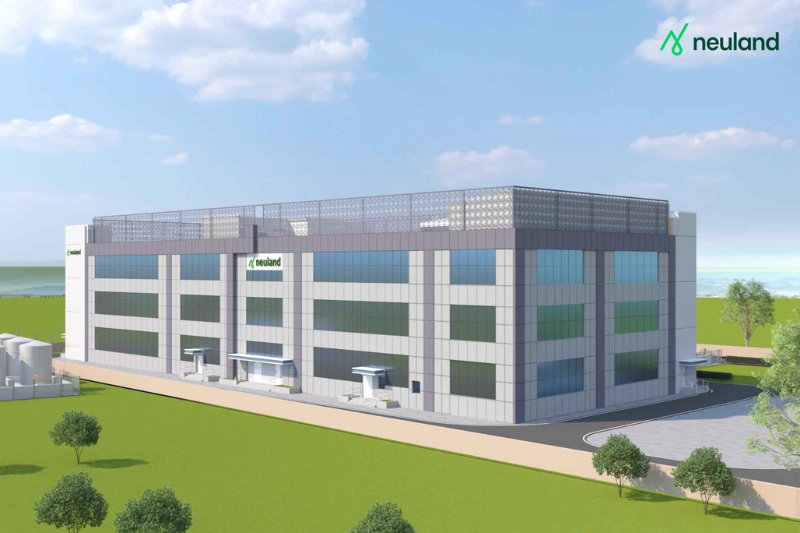
Neuland has announced that the company will open a new commercial peptide facility in the summer of 2026 at its Bonthapally manufacturing campus.
The Indian CDMO added that "further capacity expansions [are] planned as client demand increases."
The first of four planned modules is expected to be operational by the summer of this year, following the start of construction last year and will enhance Neuland's existing clinical-stage S-Block facilities with commercial-scale capabilities.
According to the API manufacturer, Module one secured firm commitments of approximately $30m and, once open, will provide 6370 L of SPPS (solid phase peptide synthesis) and LPPS (liquid phase peptide synthesis) reactor capacity for sizes of 250 L to 3000 L in LPPS, as well as SPPS reactors up to the 500 L scale.
It will enable client execution from small‑scale to multi‑ton commercial volumes, while also "providing the flexibility needed for complex and long‑chain peptide programmes."
Neuland said that it was targeting emerging biotech companies that face "tightening access to clinical and commercial manufacturing across a broad range of indications" with the rise of GLP-1 manufacturing eating up a growing share of global peptide capacity.
Saharsh Davuluri, Vice Chairman and MD at Neuland Labs, said: "The site has been designed for ongoing expansion, with space to accommodate additional SPPS synthesisers of 2kL and multiple 5kL (LPPS) reactors as future modules come online."
"This allows us to scale responsibly and in line with customer needs."
The headcount in Research and Development (R&D) at Neuland is projected to grow at a double-digit rate this year, while the manufacturing team is set to more than double in size to support this expansion.
This growth complements the CDMO's existing capacity of 1,174,000 litres of Active Pharmaceutical Ingredients (API) across three US FDA-approved facilities.
These facilities are supported by a large, dedicated R&D centre located nearby, with the integrated setup facilitating seamless scale-up, rapid technology transfer and highly efficient execution from development to commercialisation.
"Building on the strength of our reputation among innovator and biotech customers for complex API capabilities, this new facility marks our strategic entry into commercial-scale peptide manufacturing," added Davuluri.
"A key part of our strategy will be to first support innovator and emerging biotech companies across all areas of novel peptide development, as well as the ongoing demand for GLP-1 manufacturing."
We see commercial peptide production as a key growth driver for the business in the coming years. So we are now scaling rapidly and expect to roll out all modules of the new peptide facility in line with customer demand.
This latest news follows an impressive few years for the CDMO, with multiple NDAs filed on behalf of customers recently and several more expected during the next two years, reinforcing its strong regulatory track record in supporting commercial supply.
Additionally, Neuland's LPPS capabilities provide a secure supply of peptide building blocks, fragments, intermediates and hybrid constructs—strengthening supply‑chain resilience for complex peptides.
The newly completed plants feature advanced digital operation systems with DCS-based automation and eBMR integration, utilising scalable peptide technologies for synthesis, purification and drying.
The facility includes enhanced downstream capabilities, including multi-column preparative HPLC systems, commercial-grade lyophilisers, improved solvent handling, dedicated warehousing and upgraded waste management systems.
These systems aim to enable data-rich process development, reduce batch variability and improve cycle times.


