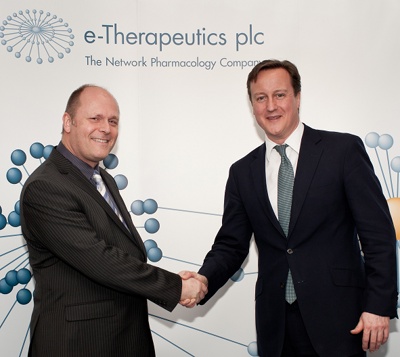
PM David Cameron opens e-Therapeutics’ drug discovery centre
Network Pharmacology Centre will search for novel treatments for cancer and CNS diseases
UK drug discovery and development firm e-Therapeutics has opened a new drug discovery centre at Long Hanborough, near Oxford.
The Network Pharmacology Centre will focus on searching for novel treatments for cancer and degenerative diseases of the nervous system.
UK Prime Minister David Cameron officially opened the centre.
He said: ‘e-Therapeutics is a fascinating and innovative business in my constituency. Their use of pioneering science has the potential to deliver great results and I very much hope that their treatments are successful.’
Professor Malcolm Young, founder and chief executive of e-Therapeutics, added: ‘We are delighted to have the Prime Minister open our new drug discovery centre near Oxford, which is a world centre of excellence in the science that underpins our business.’
The new centre will spearhead e-Therapeutics’ pioneering work in network pharmacology, which involves application of network analysis to determine the set of proteins most critical in any disease, and then chemical biology to identify molecules capable of targeting that set of proteins.
The firm says by addressing the true complexity of disease and by seeking to harness the ability of drugs to influence many different proteins, network pharmacology differs from conventional drug discovery approaches, which have generally been based on highly specific targeting of a single protein.
During 2012, e-Therapeutics plans to advance four drugs derived from network pharmacology research into clinical trials. These include potential treatments for cancer, major depressive disorder and resistant bacterial infections.
The firm’s headquarters are in Newcastle-upon-Tyne.