

Bringing an investigational medicine into an FIH study is a critical transition.

Sponsors must balance speed with sound science, patient safety, regulatory readiness and the responsible use of limited amounts of the active pharmaceutical ingredient (API).
Yet conventional development pathways can introduce delays by managing formulation, analytical work, packaging, release and supply planning as separate, sequential workstreams.
Rebecca Coutts, Senior Director of Pharmaceutical Development at PCI Pharma Services, reports.
For suitable molecules, drug-in-capsule (DIC) approaches can offer an alternative route.
Precision powder microdosing technologies, such as Xcelodose®, allow the API to be filled directly into capsules or vials without first developing a conventional powder blend.
This may reduce the extent of early preformulation activity, including excipient compatibility and prototype development, while enabling clinical material to be produced for initial studies.
The approach is not appropriate for every asset. Drug properties, dose range, clinical protocol, route of administration and longer-term development strategy must all be considered.
However, where DIC is viable, it can help sponsors to reach the clinic more efficiently and conserve valuable API.
Direct dispensing also supports dose flexibility when escalation cohorts or multiple strength presentations are needed.
Speed alone is not the objective. The clinical material must be manufactured, packaged, labelled, tested and released within a robust GMP framework.
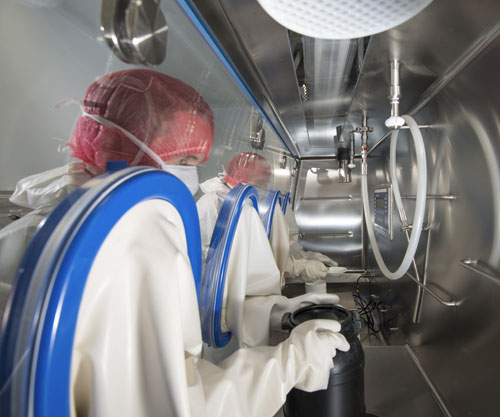
This becomes especially important for highly potent compounds when safe handling, containment and segregation are central to both operator safety and product integrity.
Packaging should therefore be considered early, rather than treated as a downstream activity.
Digital printing can offer flexibility for studies involving multiple countries, changing label requirements or smaller batch sizes, reducing the need to commit early to large volumes of preprinted packaging components.
Colocating manufacturing and packaging capabilities can also simplify material movements and handovers, reducing the operational risk associated with a fragmented supply chain.
The other essential component is clinical supply management. An FIH programme may begin with a relatively small number of sites and patients, but its supply requirements can still be complex.
Study design, stability data, recruitment assumptions, comparator availability, country requirements, labelling strategy and interactive response technology (IRT) settings all influence how much material should be manufactured, packaged and distributed.
Supply-management input at study start-up can identify these dependencies before they affect timelines.
Forecasts can then be linked to the expected dosing regimen and adjusted as live recruitment and site data become available.
This is particularly valuable when protocols change, recruitment differs from assumptions or supply constraints emerge.
The aim is to protect continuity of supply while avoiding unnecessary manufacture, expiry and waste.
An integrated FIH model brings these disciplines together: formulation and dosage-form strategy, analytical and stability planning, clinical packaging, regulatory CMC documentation, Qualified Person release and supply-chain oversight.
Rather than positioning each activity as a separate hand-off, the model encourages cross-functional decisions earlier in development.
For sponsors, the value is not simply shorter timelines. It is greater visibility of risks, clearer ownership across the development pathway and a supply strategy that can evolve alongside emerging clinical data.
In an environment in which early-stage investment decisions often depend on obtaining informative human data quickly, reducing avoidable operational complexity can make a meaningful difference.