
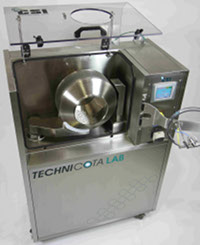
The fully self-contained laboratory tablet coating machine requires only power and compressed air to operate.
All contact parts are in 316L stainless steel, or US FDA approved materials.
The unit can be used for the development of coating processes, and also for marketing and colour matching.
The system uses a 5.7in colour touchscreen to control all operations. Heat recovery is available from all heat sources reducing energy requirements and exhaust air temperature.
Batch sizes for drum coating are from 4kg down to 400g, but there is an option to convert the system to a Wurster Column and coat batches down to 40g.
Maintenance is kept to a minimum with quick-release operator parts and push-in connectors that eliminate the need for special tools. Rapid strip down and re-assembly saves time between batches and all parts can be cleaned ultrasonically.
Tablet coating machine for small batches
The CSI Technicota LAB coats batches down to 40g when converted to a Wurster Column
You may also like
Manufacturing
![Patented device reinvents Solid Phase Extraction]()

Patented device reinvents Solid Phase Extraction
Read moreBiotech Fluidics announce SPEedy - a device that provides an effortless way to perform Solid Phase Extraction (SPE) sample preparation procedures without need of an external vacuum and compatible with any adsorption chemistry or eluent composition
Trending Articles
You may also like
Manufacturing
![Patented device reinvents Solid Phase Extraction]()
Patented device reinvents Solid Phase Extraction
Biotech Fluidics announce SPEedy - a device that provides an effortless way to perform Solid Phase Extraction (SPE) sample preparation procedures without need of an external vacuum and compatible with any adsorption chemistry or eluent composition
Manufacturing
![Orano Med inaugurates Europe's first industrial-scale lead-212 radioligand therapy facility]()

Orano Med inaugurates Europe's first industrial-scale lead-212 radioligand therapy facility
The €29m ATLab site will target up to 10,000 doses annually and its two-hour proximity to major European airports meets the critical 24-hour production-to-administration window imposed by lead-212's 10.6-hour half-life

Manufacturing
![Catalent launches ten-month gene-to-drug substance programme for complex biologics]()

Catalent launches ten-month gene-to-drug substance programme for complex biologics
The accelerated pathway extends the CDMO's Rapid Antibody framework to bispecifics and next-generation formats — targeting master cell bank release by month seven and bulk drug substance lot release by month ten
Design & Build
![Sterling Pharma Solutions doubles ADC manufacturing capacity at Deeside with new GMP suite]()

Sterling Pharma Solutions doubles ADC manufacturing capacity at Deeside with new GMP suite
The multi-million-pound expansion adds a 1400 sqft Grade C cleanroom, OEB5 containment handling and a 3400 sqft analytical laboratory — extending Sterling's bioconjugation capability from development through to Phase III and commercial scale
Manufacturing
![Piramal Pharma Solutions and NP2 to complete cyclophosphamide development phase next month]()

Piramal Pharma Solutions and NP2 to complete cyclophosphamide development phase next month
Piramal Pharma Solutions (“PPS”), a leading global Contract Development and Manufacturing Organisation (CDMO) and part of Piramal Pharma Ltd. (“PPL”) (NSE: PPLPHARMA | BSE: 543635), and its partner NP2, a nonprofit generic drug manufacturer, today announced their plans to finish the drug development phase of the generic cancer drug cyclophosphamide in October
Manufacturing
![Why your coating process is less consistent than you think - and what to do about it]()

Why your coating process is less consistent than you think - and what to do about it
Tablet coating defects rarely begin at the coating stage. In this live webinar, industry expert Fred Rowley examines the upstream variables - suspension handling, spray-rate stability, gun pattern verification - that determine whether a coating process performs consistently at scale