



Carterra has announced a research collaboration with AstraZeneca to develop hardware and software connecting laboratory systems with AI-driven drug discovery workflows.
Announced last week, the collaboration brings together Carterra’s engineering and software teams with AstraZeneca’s scientists and automation experts to advance lab-in-the-loop drug discovery, with a focus on generating standardised experimental data at scale and making it accessible to AI and machine learning systems.
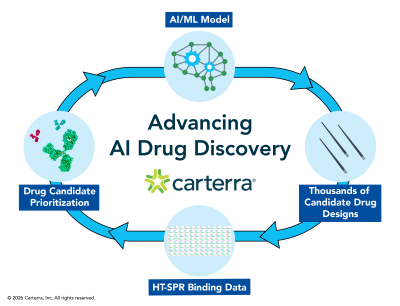 Lab-in-the-loop discovery connects computational drug design with laboratory experimentation in a continuous feedback cycle.
AI models propose candidate molecules, then run automated or semi-automated experiments to test their properties.
The resulting data informs subsequent design decisions.
Carterra, which develops high-throughput surface plasmon resonance (HT-SPR) platforms for antibody and small-molecule discovery, said the collaboration would address technical challenges involved in integrating laboratory hardware, software and data infrastructure.
The initiative comes as pharma companies increase investment in AI-enabled research and autonomous laboratory systems.
AstraZeneca is among the companies exploring ways to connect computational capabilities with experimental validation, while wider industry efforts are highlighting the importance of reliable, high-quality biological data.
“Working with one of the world's leading biopharmaceutical companies to help shape the next chapter of drug discovery is exactly the kind of collaboration our industry needs,” said Josh Eckman, CEO of Carterra.
AstraZeneca brings deep experience running biologics discovery at scale and the willingness to commit real scientific and automation resources reflects how urgently the field is moving toward a truly connected, AI-enabled discovery loop.
Standardised data for biologics discovery
A key challenge for lab-in-the-loop drug discovery is producing consistent, comparable experimental data across large numbers of experiments. Variations in experimental conditions, data formats and workflows can limit the usefulness of laboratory results for training and refining AI models.
The collaboration will therefore focus on developing laboratory systems capable of generating standardised data at scale, alongside software designed to make the resulting datasets directly usable in AI and machine learning workflows.
The approach reflects a broader shift towards integrating experimental data generation into AI drug discovery strategies, rather than treating computational modelling and laboratory validation as separate stages.
In May 2026, the OpenBind consortium released an experimental dataset and predictive AI model focused on protein–ligand interactions, highlighting the importance of generating high-quality, standardised data to improve AI-driven drug discovery.
A review published in Current Opinion in Biotechnology in February 2026 similarly identified data quality, standardisation and interoperability as important barriers to scaling autonomous laboratory workflows.


